 English
 Polski
 Deutsch
 Français
 ελληνικά
 Español
 Italiano
24,96 €

Quantity:
Total:
Total products:
Total shipping: To be determined
Total:
Science-based food supplements

Manufacturer: Kenay GmbH
Waiting for delivery
| Quantity | Price | You Save |
|---|---|---|
| 2 | 30,14 € | Up to 2,51 € |
| 4 | 29,52 € | Up to 7,54 € |
By buying this product you can collect up to 31 loyalty points. Your cart will total 31 points that can be converted during next order into a voucher of 1,55 €.

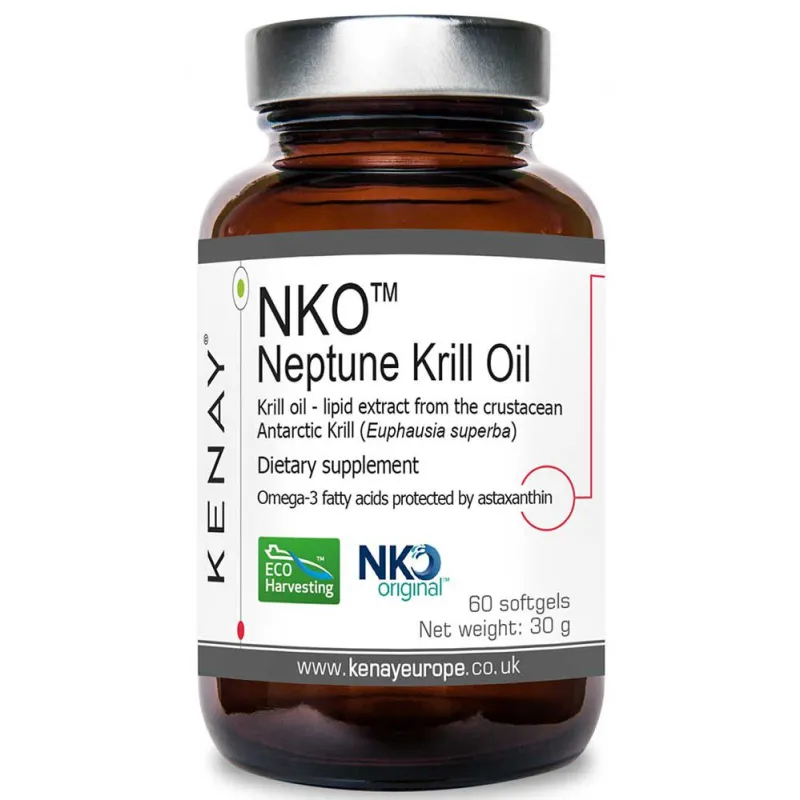
NKO™ Neptune Krill Oil
60 capsules
Item Catalog Number: K0369EN
Original product name: NKO™ Neptune Krill Oil
Antarctic krill plays important role in marine ecosystem as a feed for most fish. Krill is know source of highly bioavailable omega-3 fatty acids.
Krill oil contains a unique composition of lipids with a high concentration of phospholipids, eicosapentaenoic acid (EPA) and docosahexaenoic acid (DHA). It also contains considerable amounts of other bioactive components such as astaxanthin, sterols, tocopherols, vitamin A, flavonoids, and minerals.[1,2] The NKO™ formula is a synergistic combination of essential fatty acids, phospholipids and antioxidants.
Because of astaxanthin, krill oil is more durable and does not turn rancid like traditional fish oils. Our NKO™ Krill Oil supplement has no unpleasant, fishy aftertaste. Moreover, it doesn't cause or worsen heartburn. It also doesn't cause other side effects.
Krill oil shows various health benefits, including anti-inflammatory effects, cardiovascular disease prevention and neuroprotection.[1,2]
Benefits at a Glance:
Important risk factors of Cardiovascular diseases include high blood pressure, high serum triglycerides, low HDL-cholesterol level, endothelial dysfunction and tendency to thrombosis and inflammation.[12]
Large number of studies shows that EPA and DHA lower triglycerides [12,13], lower the blood pressure (both systolic and diastolic) [12,13,14], regulate heart function and stabilizing the heart rate [12,13,15-17], reduce platelet aggregation [12,18] and reduce the level of triglycerides.
It has been proven that the use of omega-3 fatty acids reduces mortality from cardiovascular diseases.
Krill oil supplementation lowers serum triglyceride without increasing low-density lipoprotein cholesterol in adults with borderline high or high triglyceride levels.[6,7]
In a 12-weeks trial, 300 male and female subjects were included in a double-blind, randomized, multi-center, placebo-controlled study with five treatment groups: placebo (olive oil) or 0.5, 1, 2, or 4 g/day of krill oil.[6,7]
Serum lipids were measured after an overnight fast at baseline, 6 and 12 weeks. Relative to subjects in the placebo group, those administered krill oil had a statistically significant calculated reduction in serum triglyceride levels of 10.2%. Moreover, LDL levels were not increased in the krill oil groups relative to the placebo group. The outcome of the pooled analysis suggests that krill oil is effective in reducing a cardiovascular risk factor.[6,7]
As fish oils, also krill oil increase plasma and cell membrane concentrations of omega-3 fatty acids.
Astaxanthin, found in krill oil, is a poten antioxidant which has been shown to also have anti-inflammatory. Those properties may help fight the negative effects of free radicals on brain and nervous system. [4] Astaxanthin also boost mitochondrial function.
Omega-3 fatty acids found in krill oil have better bioavailability than those derived from fish oil. In krill oil, EPA and DHA are found as fospholipids whille in fish oil, the DHA and EPA are found as triglycerides.[4] Krill oil contains ultra-potent phospholipids that may help to maintain normal brain function. Phospholipids also enhances cell signaling which is crucial for both, healthy nervous system and brain functions.[3]
Human studies confirm cognition and memory improvement with Krill's omega-3 supplementation. One study showed that krill oil enhanced cognitive function in a group of older men by increasing oxygen delivery to their brains. DHA in krill oil is bound to phospholipids, thus it why is more effectively incorporated into the critical cell membrane in brain cells. [3]
Krill oil may reduce arthritis and joint pain. Ninety patients were participated with diagnosed cardiovascular disease, rheumatoid arthritis and osteoarthritis. One group received 300 mg of krill oil daily and second group received a placebo. The study showed that krill oil at a daily dose of 300 mg significantly inhibits inflammation and reduces arthritic symptoms within a short treatment period of 7 and 14 days.[10,11]
In a 6-month multicenter, randomized, double-blind, placebo-controlled trial, Krill oil improved osteoarthritic knee pain in adults with mild to moderate knee osteoarthritis.[9]
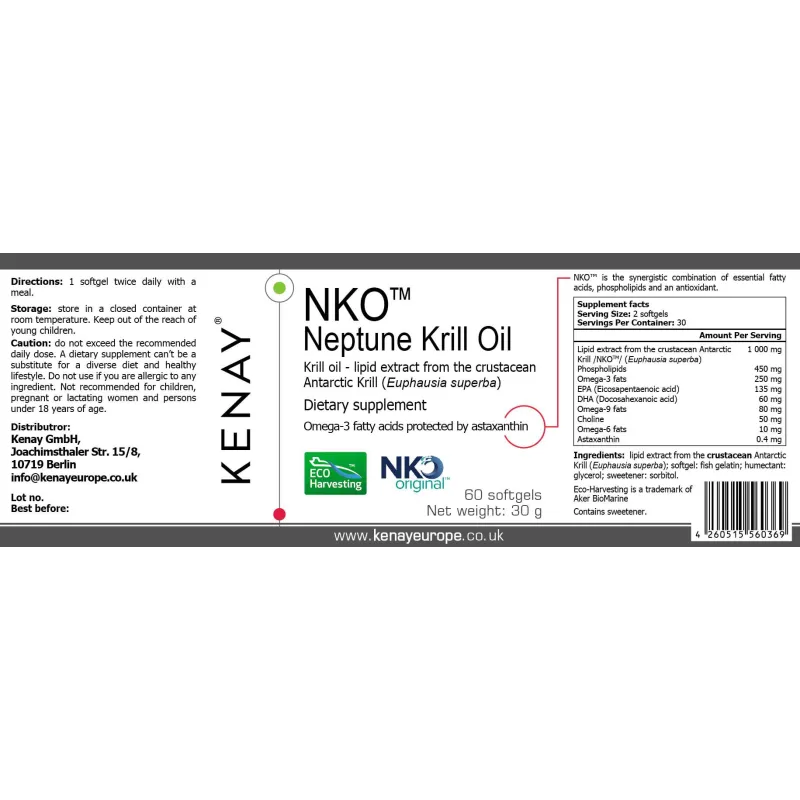
Daily dose: 2 capsules
| Amount per day: (2 capsules) | |
|---|---|
| Lipid extract from the Antarctic krill crustacean /NKO™/ (Euphasia superba) | 1000 mg |
| Phospholipids | 450 mg |
| Omega-3: | 250 mg |
| EPA (eicosapentaenoic acid) | 135 mg |
| DHA (docosahexaenoic acid) | 60 mg |
| Omega-9 | 80 mg |
| Choline | 50 mg |
| Omega-6 | 10 mg |
| Astaxanthin | 0,4 mg |
| Ingredients: lipid extract from the crustacean Antarctic krill (Euphasia superba); softgel: fish gelatin; humectant: glycerol; sweetener: sorbitol. | |
Eco-HarvestingTM is a trademark of Aker BioMarine.
Dosage and Use
Take 1 (one) capsule 2 times a day, while eating or as recommended by a healthcare practitioner.
Storage: Store in a closed container at room temperature, out of the reach of small children.
Warnings:
Before you start using any dietary supplement, consult your doctor.
Dietary supplements are not medicines.
Do not exceed the recommended daily dose.
Dietary supplements cannot be used as a substitute for a varied diet.
Do not use in case of hypersensitivity to any ingredient of the preparation.
The product should not be used by pregnant or breastfeeding women and children and adolescents under 18 years of age.
24,96 €
21,53 €

38,53 €

34,72 €


















NKO (Neptune Krill Oil) represents the original and most extensively researched krill oil with over 20 clinical studies validating its unique advantages over conventional fish oil. The fundamental difference lies in molecular structure—krill oil omega-3s (EPA and DHA) are predominantly bound to phospholipids rather than triglycerides, dramatically enhancing bioavailability and cellular uptake. Research demonstrates that phospholipid-bound omega-3s achieve 1.5-2.5 times higher blood levels compared to equivalent doses of fish oil triglycerides. This superior absorption means lower doses provide therapeutic benefits—500 mg NKO delivers omega-3 effects comparable to 1000-1500 mg standard fish oil. Beyond enhanced bioavailability, NKO contains the powerful antioxidant astaxanthin (1.5 mg per gram), giving krill oil its distinctive red color and protecting omega-3s from oxidation. Fish oil typically requires added synthetic antioxidants like vitamin E, while krill oil's natural astaxanthin provides superior protection. The phospholipid structure also enables omega-3s to integrate directly into cell membranes without requiring metabolic conversion, ensuring rapid and efficient cellular delivery. NKO undergoes proprietary eco-harvesting from pristine Antarctic waters with MSC (Marine Stewardship Council) certification, guaranteeing sustainability and purity superior to fish oil sources often contaminated with heavy metals, PCBs, and other pollutants.
NKO krill oil provides comprehensive cardiovascular benefits through multiple synergistic mechanisms involving omega-3 fatty acids, phospholipids, and astaxanthin. Clinical trials demonstrate significant improvements in lipid profiles—LDL cholesterol reductions of 32-39%, triglyceride decreases of 26-28%, and HDL increases of 42-60% after 12 weeks at 1-3 grams daily. These improvements exceed those typically seen with equivalent doses of fish oil, attributed to phospholipid-enhanced absorption and direct effects on hepatic lipid metabolism. The omega-3s EPA and DHA reduce inflammatory prostaglandin and leukotriene production, with studies showing 19-30% reductions in inflammatory markers like CRP and IL-6. This anti-inflammatory activity protects vascular endothelium, improves arterial elasticity, and reduces atherosclerotic plaque formation. Research shows 11-15% improvements in flow-mediated dilation, indicating better endothelial function and vascular health. Beyond lipids and inflammation, krill oil supports healthy blood pressure through endothelial nitric oxide production and arterial relaxation, with typical decreases of 4-7 mmHg in individuals with elevated readings. The phosphatidylcholine in krill oil supports healthy homocysteine metabolism, reducing this cardiovascular risk factor by 10-20%. Astaxanthin provides additional cardiovascular protection through potent antioxidant activity, preventing LDL oxidation and protecting heart tissue from oxidative stress.
NKO demonstrates exceptional efficacy for joint health and inflammatory conditions through its unique combination of bioavailable omega-3s and astaxanthin. Clinical research specifically examining krill oil for osteoarthritis and joint pain shows remarkable results—after just 7 days, participants experienced 20-29% reductions in pain scores, with effects improving progressively over 30 days to 47-55% pain reduction. This rapid response significantly exceeds typical fish oil timelines, attributed to the superior bioavailability of phospholipid-bound omega-3s. Functional improvements accompany pain relief, with 22-27% reductions in stiffness and 20-30% improvements in range of motion measured through standardized assessments. The mechanisms involve both systemic anti-inflammatory effects—reducing inflammatory cytokines and prostaglandins throughout the body—and direct effects on joint tissues. Research shows krill oil reduces cartilage degradation markers and may support cartilage matrix preservation. Astaxanthin contributes additional anti-inflammatory and antioxidant benefits, with studies demonstrating superior joint protective effects compared to omega-3s alone. Beyond osteoarthritis, krill oil benefits individuals with rheumatoid arthritis, with trials showing reduced morning stiffness, decreased joint tenderness, and improvements in functional capacity. Athletes experience reduced exercise-induced inflammation and faster recovery, with 30-40% reductions in delayed onset muscle soreness. The low effective dose (500-1000 mg daily) makes krill oil practical for long-term joint support.
The phospholipid-bound DHA in NKO krill oil provides unique advantages for brain health and cognitive function compared to standard fish oil. Brain cell membranes are composed primarily of phospholipids, making krill oil's phosphatidylcholine-bound DHA ideally structured for direct incorporation into neuronal membranes without metabolic conversion requirements. Research demonstrates that phospholipid DHA crosses the blood-brain barrier more efficiently than triglyceride forms, achieving higher brain tissue concentrations at equivalent doses. Clinical studies show krill oil supplementation improves cognitive performance measures including working memory (15-20% improvement in recall tasks), processing speed (12-18% faster reaction times), and executive function. These effects emerge within 6-12 weeks and continue improving with sustained use. For age-related cognitive decline, krill oil demonstrates neuroprotective benefits through multiple mechanisms: reducing neuroinflammation by 20-35%, protecting neurons from oxidative damage through astaxanthin's antioxidant activity, and supporting neuroplasticity through brain-derived neurotrophic factor (BDNF) upregulation. Elderly individuals with mild cognitive impairment show particular benefit, with trials demonstrating 10-25% improvements in cognitive assessment scores after 12-24 weeks. The anti-inflammatory effects extend to mood regulation—clinical research shows krill oil reduces depression and anxiety symptoms by 20-30% comparable to higher doses of fish oil. Phosphatidylserine and phosphatidylcholine in krill oil provide additional cognitive support through improved cell signaling and neurotransmitter function.
Clinical research with NKO supports dosing ranges of 500-3000 mg daily depending on health goals and condition severity. For general cardiovascular and anti-inflammatory support, 500-1000 mg daily (providing approximately 100-200 mg combined EPA/DHA) offers meaningful benefits equivalent to 1000-2000 mg fish oil due to superior bioavailability. Individuals targeting significant lipid improvements, particularly triglyceride reduction, benefit from 1000-2000 mg daily, the dose range demonstrating 26-28% triglyceride decreases in clinical trials. For joint health and osteoarthritis, studies show 300 mg daily produces rapid pain relief, while 500-1000 mg may provide optimal long-term benefits for inflammation reduction and cartilage support. Cognitive enhancement and brain health applications typically utilize 1000-1500 mg daily to ensure adequate DHA delivery to neural tissues. Taking krill oil with meals, particularly those containing fat, optimizes absorption and reduces the mild gastrointestinal effects some individuals experience. Unlike fish oil which often causes fishy burps and aftertaste, krill oil's phospholipid structure minimizes these issues, with most users reporting no digestive discomfort even without refrigeration. Effects develop progressively—anti-inflammatory benefits emerge within 1-2 weeks, joint pain relief within 7-14 days, lipid improvements manifest over 4-8 weeks, and cognitive benefits require 8-12 weeks. The excellent safety profile supports long-term continuous use without cycling requirements. Starting with 500 mg daily allows tolerance assessment before increasing to therapeutic doses based on individual response and health objectives.
Results: Clinical trials demonstrate NKO krill oil supplementation at 1-3 grams daily reduces LDL cholesterol by 32-39%, decreases triglycerides by 26-28%, and increases HDL cholesterol by 42-60% after 12 weeks, exceeding improvements seen with equivalent fish oil doses.
Citation: Bunea R, et al. Altern Med Rev. 2004 Dec;9(4):420-8.
Results: Research shows krill oil reduces joint pain by 28.9% after 7 days and 55% after 30 days in osteoarthritis patients, with significant improvements in stiffness and functional capacity measured through WOMAC scores compared to placebo groups.
Citation: Deutsch L. J Am Coll Nutr. 2007 Feb;26(1):39-48.
Results: Studies reveal phospholipid-bound omega-3s from krill oil achieve 1.5-2.5 fold higher plasma concentrations compared to triglyceride fish oil at equivalent doses, with superior incorporation into red blood cell membranes indicating enhanced bioavailability.
Citation: Schuchardt JP, et al. Lipids Health Dis. 2011 Aug;10:145.
Results: Cognitive trials show krill oil supplementation improves working memory by 15-20% and reduces inflammatory markers by 19-30%, with astaxanthin providing additional neuroprotective benefits through antioxidant mechanisms.
Citation: Konagai C, et al. J Clin Biochem Nutr. 2013 Nov;53(3):127-37.