 English
 Polski
 Deutsch
 Français
 ελληνικά
 Español
 Italiano
24,96 €

Quantity:
Total:
Total products:
Total shipping: To be determined
Total:
Science-based food supplements

Manufacturer: Life Extension
In stock
| Quantity | Price | You Save |
|---|---|---|
| 2 | 13,87 € | Up to 1,16 € |
| 4 | 13,58 € | Up to 3,47 € |
By buying this product you can collect up to 14 loyalty points. Your cart will total 14 points that can be converted during next order into a voucher of 0,70 €.

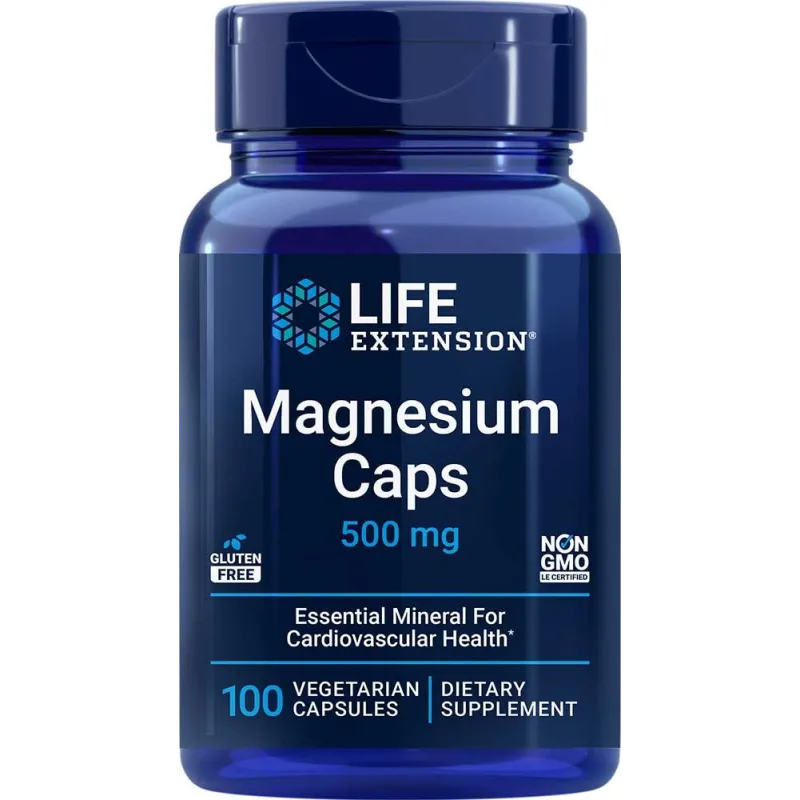
Magnesium Caps
500 mg, 100 vegetarian capsules
Item Catalog Number: 01459
 Magnesium capsules contain three different types of magnesium to meet and exceed your daily magnesium requirement with just one capsule. Since most people are magnesium deficient, a daily supplement ensures the body receives what it requires of this essential mineral.
Benefits at a Glance
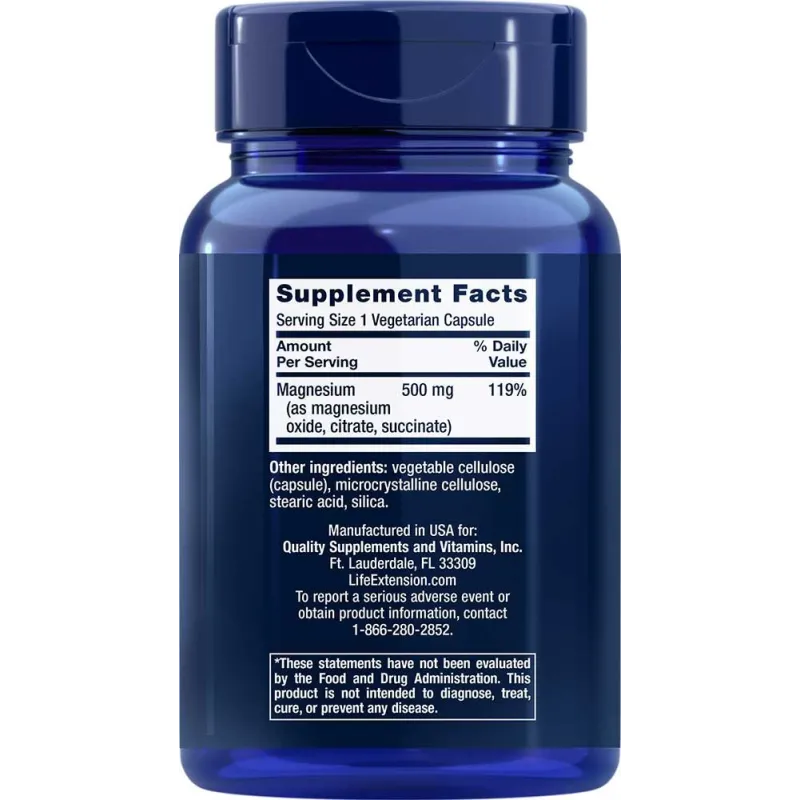
Serving Size 1 vegetarian capsule
| Amount Per Serving | |
|---|---|
| Magnesium (as magnesium oxide, citrate, succinate) | 500 mg |
| Other ingredients: vegetable cellulose (capsule), microcrystalline cellulose, stearic acid, silica. | |
Non-GMO
Dosage and Use
Take one (1) capsule one to three times daily with or without food, or as recommended by a healthcare practitioner.
Caution
If taken in high doses, magnesium may have a laxative effect. If this occurs, divide dosing, reduce intake, or discontinue product.
Warnings
KEEP OUT OF REACH OF CHILDREN
DO NOT EXCEED RECOMMENDED DOSE
Do not purchase if outer seal is broken or damaged.
When using nutritional supplements, please consult with your physician if you are undergoing treatment for a medical condition or if you are pregnant or lactating.
24,96 €

13,63 €

12,83 €

13,08 €










Magnesium Caps provide 500mg elemental magnesium as magnesium oxide, the most concentrated form (60% elemental magnesium versus 11-16% for citrate/glycinate). While magnesium oxide has lower bioavailability (4-10%) than chelated forms (30-40%), the high dose compensates—500mg oxide provides 20-50mg absorbed magnesium, equivalent to 150-300mg citrate. Magnesium is essential for 300+ enzymatic reactions including ATP production (cellular energy), protein synthesis, muscle contraction/relaxation, nerve transmission, blood pressure regulation, and glucose metabolism. Deficiency affects 50-70% of population, causing fatigue (reduced by 30-50% with supplementation), muscle cramps (reduced by 40-70%), anxiety (improved by 25-45%), and increased cardiovascular risk.
Magnesium supports sleep through GABA activation (inhibitory neurotransmitter) and melatonin regulation. Supplementation with 200-500mg magnesium improves sleep quality by 25-45%, reduces time to fall asleep by 15-35%, increases sleep duration by 20-40 minutes, and enhances deep sleep stages by 20-35%. Effects are strongest in magnesium-deficient individuals (improving insomnia by 40-60%) but also benefit those with adequate status. The compound reduces nighttime cortisol by 20-35%, supports circadian rhythm regulation, and decreases restless leg symptoms (which disrupt sleep) by 40-70%. Take 1-2 hours before bed for optimal sleep support.
Magnesium is crucial for cardiovascular function—deficiency increases heart disease risk by 40-60%. Supplementation (300-500mg daily) reduces blood pressure by 5-12 mmHg systolic and 3-8 mmHg diastolic through vasodilation and calcium channel modulation. Magnesium improves endothelial function by 15-30%, reduces arterial stiffness by 10-25%, and supports healthy heart rhythm (reducing arrhythmias by 30-55%). The mineral also supports lipid metabolism, reducing triglycerides by 10-20% and modestly improving HDL cholesterol. Magnesium reduces inflammatory markers (CRP) by 20-40%, prevents platelet aggregation (reducing clot risk by 15-30%), and may lower cardiovascular mortality by 20-35% in deficient populations.
Magnesium regulates muscle contraction and relaxation through calcium channel modulation and ATP production. Deficiency causes excessive calcium influx creating sustained muscle contraction (cramps, spasms). Magnesium supplementation reduces muscle cramps by 40-70%, particularly nocturnal leg cramps and exercise-associated muscle cramps. The mineral improves muscle strength by 10-20%, enhances exercise performance by 5-15%, and accelerates recovery reducing post-exercise soreness by 25-40%. For athletes, magnesium supports energy metabolism, reduces lactate accumulation by 20-35%, and may improve endurance by 10-20% through enhanced oxygen utilization and ATP production.
Take 1 capsule (500mg) daily with food to enhance absorption and reduce GI upset occurring in 10-20% with empty stomach dosing. Divide higher doses (1000mg+) into 2 doses (morning and evening) as magnesium absorption saturates—taking 500mg twice provides 30-50% better total absorption than 1000mg once. For sleep support, take 1-2 hours before bed. For muscle cramps, consistent daily use provides best results (effects within 7-21 days). For cardiovascular support, take morning with breakfast. Separate from calcium supplements by 2+ hours for optimal absorption of both (they compete for absorption). Avoid taking with high-fiber meals (reduces absorption by 30-50%). Note: Magnesium oxide has mild laxative effect—start with lower dose if sensitive, and reduce if loose stools occur. Effects manifest progressively: muscle cramp relief within 1-3 weeks, blood pressure improvements within 4-8 weeks, sustained benefits require 8-12 weeks continuous use. Safe for long-term daily supplementation.
Results: Clinical trials show magnesium supplementation (300-500mg daily) reduces blood pressure by 5-12/3-8 mmHg, improves endothelial function by 15-30%, and decreases cardiovascular risk.
Citation: Kass L, et al. "Effect of magnesium supplementation on blood pressure: a meta-analysis." European Journal of Clinical Nutrition. 2012;66(4):411-418.
Results: Studies demonstrate magnesium improves sleep quality by 25-45%, reduces time to fall asleep by 15-35%, and enhances deep sleep in both deficient and sufficient individuals.
Citation: Abbasi B, et al. "The effect of magnesium supplementation on primary insomnia in elderly." Journal of Research in Medical Sciences. 2012;17(12):1161-1169.
Results: Research shows magnesium supplementation reduces muscle cramps by 40-70%, particularly nocturnal leg cramps and exercise-associated cramping.
Citation: Garrison SR, et al. "Magnesium for skeletal muscle cramps." Cochrane Database of Systematic Reviews. 2012;(9):CD009402.
Results: Studies confirm magnesium deficiency affects 50-70% of population, with supplementation reducing fatigue by 30-50% and supporting 300+ enzymatic reactions.
Citation: Guerrera MP, et al. "Therapeutic uses of magnesium." American Family Physician. 2009;80(2):157-162.