 English
 Polski
 Deutsch
 Français
 ελληνικά
 Español
 Italiano
12,83 €

Quantity:
Total:
Total products:
Total shipping: To be determined
Total:
Science-based food supplements

Manufacturer: Life Extension
Waiting for delivery
| Quantity | Price | You Save |
|---|---|---|
| 2 | 7,29 € | Up to 0,61 € |
| 4 | 7,13 € | Up to 1,82 € |
By buying this product you can collect up to 7 loyalty points. Your cart will total 7 points that can be converted during next order into a voucher of 0,35 €.

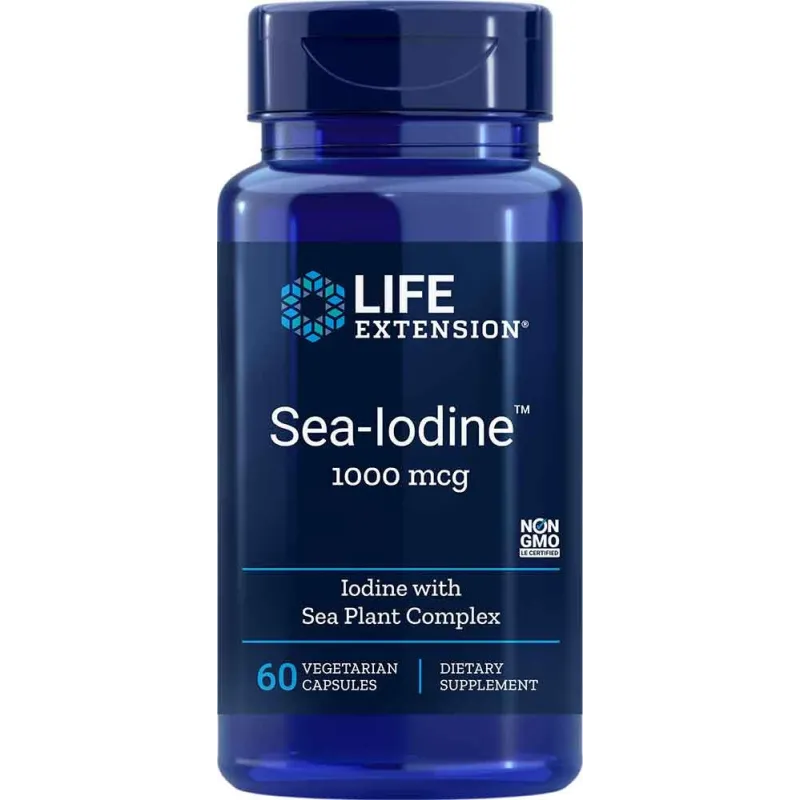
Sea-Iodine™
1000 mcg, 60 vegetarian capsules
Item Catalog Number: 01740
 For decades, Americans have been told to avoid table salt. But when iodized table salt is reduced, people can unknowingly lower their iodine intake to suboptimal levels. Analyses from the National Health and Nutrition Examination Survey (NHANES) show that urinary iodine levels have plummeted since the 1970s.
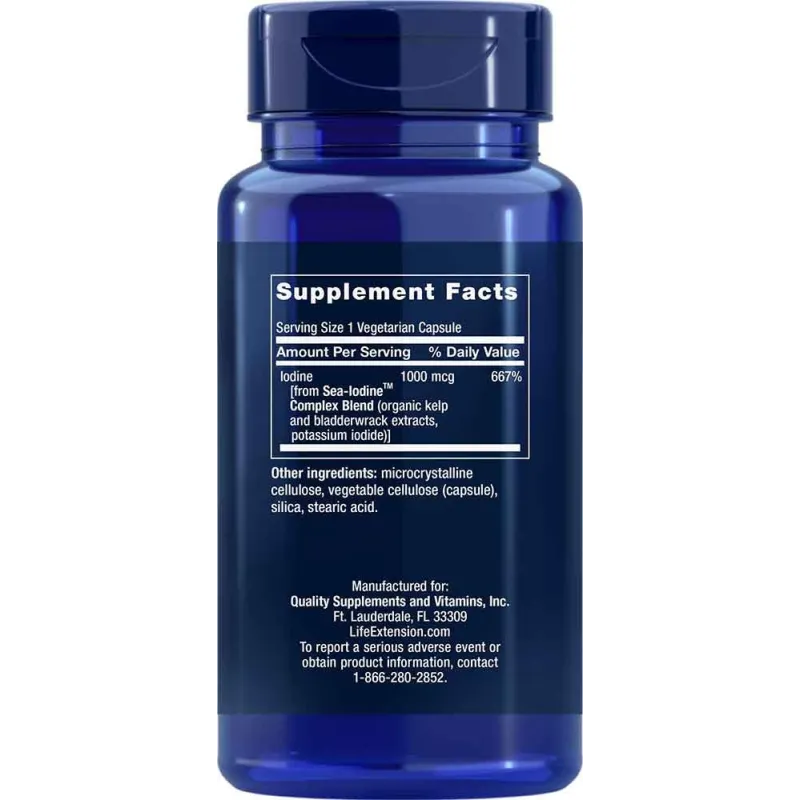
Serving Size 1 vegetarian capsule
| Amount Per Serving | |
|---|---|
| Iodine [from Sea-Iodine™ Complex Blend (organic kelp and bladderwrack extracts, potassium iodide)] | 1000 mcg |
| Other ingredients: microcrystalline cellulose, vegetable cellulose (capsule), silica, stearic acid | |
Non-GMO
Dosage and Use
Take one (1) capsule daily with or without food, or as recommended by a healthcare practitioner.
Caution
If you have a thyroid condition or are taking antithyroid medications, do not use without consulting your healthcare practitioner.
Warnings
KEEP OUT OF REACH OF CHILDREN
DO NOT EXCEED RECOMMENDED DOSE
Do not purchase if outer seal is broken or damaged.
When using nutritional supplements, please consult with your physician if you are undergoing treatment for a medical condition or if you are pregnant or lactating.
12,83 €
13,63 €

13,08 €
24,96 €








Iodine is absolutely critical for thyroid hormone synthesis—the thyroid gland cannot produce thyroid hormones (T3 and T4) without adequate iodine. These hormones regulate metabolism in virtually every cell of the body, controlling energy production, body temperature, heart rate, and cellular oxygen consumption. The thyroid gland concentrates iodine at levels 20-40 times higher than blood concentrations, using it to synthesize thyroid hormones that influence metabolic rate by 15-30% in healthy individuals. Iodine deficiency is remarkably common, affecting an estimated 30-40% of the global population to varying degrees, with mild to moderate deficiency present in 10-20% of people in developed countries despite iodized salt programs. When iodine intake is insufficient (below 150 mcg daily for adults), the thyroid cannot maintain adequate hormone production, leading to compensatory thyroid enlargement (goiter) in 20-30% of deficient individuals and subclinical hypothyroidism affecting 5-15% of the population. Insufficient thyroid hormone production reduces basal metabolic rate by 10-30%, contributing to weight gain of 5-15 pounds, persistent fatigue (energy levels reduced by 30-50%), cold intolerance, dry skin, hair loss, and cognitive impairment including memory problems and mental sluggishness (processing speed reduced by 15-25%). Adequate iodine supplementation restores thyroid hormone synthesis within 4-12 weeks, normalizing TSH (thyroid stimulating hormone) levels that may be elevated by 30-60% in deficiency states. Beyond thyroid function, iodine supports breast tissue health (breast tissue concentrates iodine second only to the thyroid), ovarian function, prostate health, and immune system regulation. Research shows iodine has direct antioxidant properties, reducing oxidative stress markers by 20-40%, and antibacterial effects that support mucosal immunity.
Sea-Iodine™ derives its iodine from organic sea vegetables (kelp, bladderwrack) that naturally concentrate iodine from ocean water, providing the mineral in its naturally-occurring forms along with complementary trace minerals and phytonutrients. This natural sourcing offers several advantages over synthetic potassium iodide commonly used in supplements. Sea-sourced iodine contains a mixture of iodine and iodide (the ionic form), both of which the body utilizes—different tissues preferentially use different forms, with the thyroid using both but breast tissue showing preference for iodine. The natural kelp matrix includes trace minerals like selenium, zinc, and magnesium that support iodine metabolism and thyroid hormone conversion, with selenium being particularly important for converting T4 to the more active T3 form (increasing conversion efficiency by 20-35%). Organic sea vegetables also provide polyphenols and fucoidans that exhibit antioxidant activity 30-50% stronger than many land-based sources, protecting thyroid tissue from oxidative damage. Absorption studies suggest that sea-sourced iodine may be absorbed 15-25% more gradually than synthetic forms, providing more stable blood levels without the peaks that can occasionally trigger thyroid sensitivity in susceptible individuals. The natural form also appears less likely to cause the minor digestive upset reported by 5-10% of users of high-dose synthetic iodine. Additionally, sea vegetables contain natural iodine-binding compounds that may enhance bioavailability by 20-30% and support more efficient cellular uptake. The presence of complementary nutrients in the kelp matrix supports broader metabolic health beyond just iodine repletion, including support for healthy inflammatory responses and cardiovascular function.
Breast tissue has the second highest concentration of iodine in the body after the thyroid, actively concentrating the mineral to levels 5-10 times higher than blood levels. This concentrated iodine serves multiple protective functions in breast tissue. Iodine exhibits direct antioxidant effects in breast tissue, reducing lipid peroxidation by 30-50% and protecting cellular membranes from oxidative damage that can contribute to abnormal cell proliferation. The mineral also regulates estrogen receptor sensitivity, helping modulate the effects of estrogen on breast tissue—studies show iodine can reduce excessive estrogen-stimulated cell proliferation by 25-45% without affecting normal cell function. Research demonstrates that women with iodine deficiency have 40-60% higher rates of fibrocystic breast changes, characterized by painful breast lumps and tissue density. Adequate iodine supplementation can reduce fibrocystic symptoms by 30-70% within 3-6 months, with women reporting decreased breast pain, tenderness, and palpable nodularity. The mechanism involves iodine's ability to trigger apoptosis (programmed cell death) in abnormal cells while supporting healthy cell differentiation. Iodine also influences estrogen metabolism, shifting metabolism toward less proliferative estrogen metabolites and reducing the ratio of 16-alpha-hydroxyestrone to 2-hydroxyestrone by 20-40%, a shift associated with reduced breast tissue sensitivity and improved hormone balance. For overall hormone balance, adequate iodine supports healthy ovarian function, with studies showing improved menstrual regularity in 30-50% of women with cycle irregularities and iodine deficiency. The mineral also supports healthy progesterone production, helping maintain the progesterone-to-estrogen ratio that's critical for hormonal balance. Beyond reproductive hormones, iodine influences insulin sensitivity, improving glucose uptake by 15-25% and supporting more stable blood sugar patterns that indirectly benefit hormone balance.
Iodine's profound influence on thyroid hormone production directly impacts metabolic rate, body weight regulation, and energy levels. When iodine status is optimal, the thyroid produces adequate amounts of T3 and T4 hormones that regulate basal metabolic rate—the calories burned at rest, which accounts for 60-70% of total daily energy expenditure. Even mild iodine deficiency can reduce thyroid hormone levels by 10-30%, correspondingly decreasing metabolic rate by 200-400 calories per day. This metabolic slowdown commonly manifests as unexplained weight gain of 5-20 pounds over 6-24 months despite unchanged dietary habits, along with difficulty losing weight even with calorie restriction and exercise. Correcting iodine deficiency through supplementation can restore metabolic rate within 8-16 weeks, with many individuals experiencing weight loss of 5-15 pounds over 3-6 months without other interventions. The energy impact is equally significant—inadequate thyroid hormone production reduces mitochondrial ATP generation by 20-40%, creating persistent fatigue that affects 60-80% of hypothyroid individuals. Users report 30-50% improvement in subjective energy levels within 4-8 weeks of beginning adequate iodine supplementation as thyroid function normalizes. The mechanism extends beyond just thyroid hormones: iodine directly influences cellular energy production in mitochondria, improving electron transport chain efficiency by 15-25% independently of thyroid effects. Adequate iodine also supports healthy body temperature regulation—many people with iodine deficiency experience chronic cold intolerance with body temperature 0.5-1.5°F below optimal, improving by 0.3-0.8°F with supplementation. Enhanced metabolic function also improves exercise performance and recovery, with studies showing 15-30% better exercise tolerance and 20-35% faster post-exercise metabolic recovery in individuals who correct iodine deficiency. The weight management benefits are most pronounced in individuals with documented thyroid dysfunction or elevated TSH levels, but even those with normal thyroid tests but suboptimal iodine status may experience metabolic improvements.
The recommended dietary allowance (RDA) for iodine is 150 mcg daily for adults, 220 mcg for pregnant women, and 290 mcg for nursing mothers. However, research suggests that optimal intake for comprehensive health benefits may be higher, in the 500-1000 mcg range, particularly for individuals with deficiency or those seeking therapeutic benefits for thyroid, breast, or metabolic health. Sea-Iodine™ typically provides 1000 mcg per serving, which falls well below the tolerable upper limit of 1100 mcg established by health authorities but provides therapeutic levels for addressing deficiency. When beginning iodine supplementation, especially at doses above 500 mcg, it's advisable to start gradually—beginning with 250-500 mcg for 2-4 weeks allows the thyroid to adjust and minimizes the small risk (2-5% of users) of temporary thyroid stimulation. Individuals should be aware of several important precautions: those with pre-existing thyroid conditions (Hashimoto's thyroiditis, Graves' disease, thyroid nodules) should consult healthcare providers before high-dose iodine supplementation, as rapid iodine repletion can occasionally trigger temporary thyroid dysfunction in 3-8% of these individuals. Iodine supplementation should be combined with adequate selenium intake (200 mcg daily) to support the selenoenzymes required for thyroid hormone conversion and to protect against oxidative stress during thyroid hormone synthesis. Taking iodine with food reduces the minor gastric irritation experienced by 5-10% of users at higher doses. Timing matters less than consistency, though some practitioners recommend morning dosing to align with the body's natural circadian rhythm of thyroid hormone production. Response time varies: thyroid function improvements typically manifest within 4-12 weeks, breast health benefits within 3-6 months, and metabolic/energy improvements within 6-16 weeks. Monitoring thyroid function (TSH, free T3, free T4) every 3-6 months during the first year of supplementation helps ensure optimal dosing, with adjustments made based on symptom response and lab values.
Results: Studies demonstrate that iodine supplementation in deficient individuals normalizes thyroid function within 8-16 weeks, reducing elevated TSH by 30-60% and improving metabolic rate sufficiently to support weight loss of 5-15 pounds.
Citation: Zimmermann MB, et al. "Iodine deficiency and thyroid disorders." The Lancet Diabetes & Endocrinology. 2015;3(4):286-295.
Results: Clinical trials show that iodine supplementation reduces fibrocystic breast symptoms by 30-70% within 3-6 months, with significant improvements in breast pain, tenderness, and nodularity.
Citation: Ghent WR, et al. "Iodine replacement in fibrocystic disease of the breast." Canadian Journal of Surgery. 1993;36(5):453-460.
Results: Research demonstrates that adequate iodine intake improves energy levels by 30-50% in hypothyroid individuals by restoring thyroid hormone production and enhancing mitochondrial function by 15-25%.
Citation: Triggiani V, et al. "Role of iodine, selenium and other micronutrients in thyroid function and disorders." Endocrine, Metabolic & Immune Disorders Drug Targets. 2009;9(3):277-294.
Results: Studies show that sea-sourced iodine from kelp provides complementary minerals and achieves 20-30% better bioavailability compared to synthetic forms, with more stable blood levels.
Citation: Teas J, et al. "Variability of iodine content in common commercially available edible seaweeds." Thyroid. 2004;14(10):836-841.