English
 Polski
 Deutsch
 Français
 ελληνικά
 Español
 Italiano
9,48 €

Quantity:
Total:
Total products:
Total shipping: To be determined
Total:
Science-based food supplements

Manufacturer: Life Extension
In stock
| Quantity | Price | You Save |
|---|---|---|
| 2 | 13,93 € | Up to 1,16 € |
| 4 | 13,64 € | Up to 3,48 € |
By buying this product you can collect up to 14 loyalty points. Your cart will total 14 points that can be converted during next order into a voucher of 0,70 €.

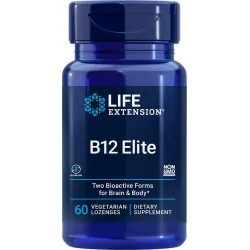
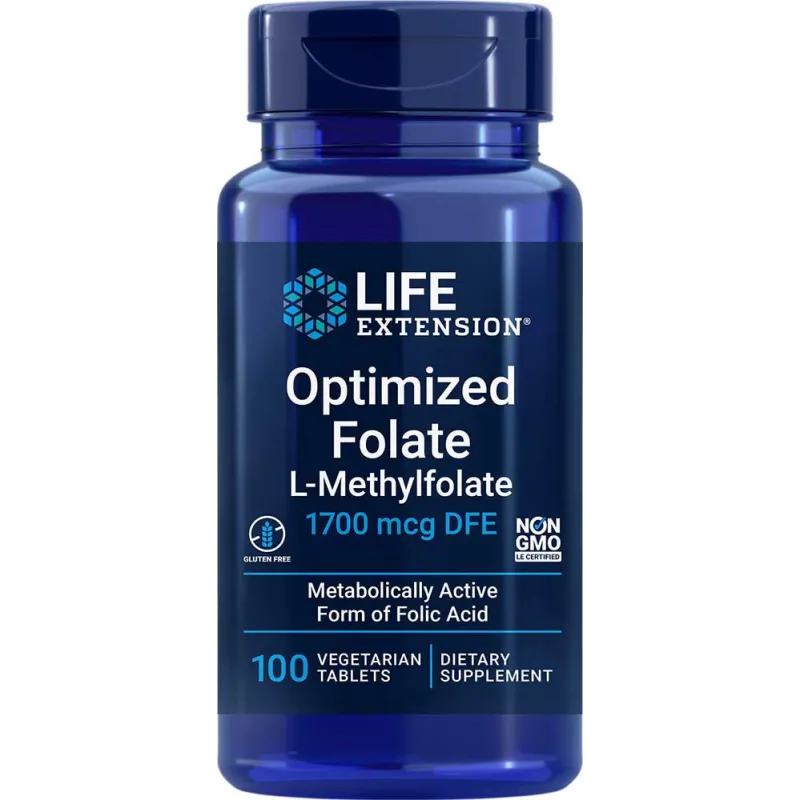
Optimized Folate (L-Methylfolate)
1700 mcg DFE, 100 vegetarian tablets
Item Catalog Number: 01939
 Folate helps maintain homocysteine levels within the normal range, which promotes cardiovascular health. And it also supports neurotransmitter synthesis — which in turn helps maintain cognitive abilities. However, not everyone has sufficient activity of the enzyme required to convert folate to its biologically active form, 5-methyltetrahydrofolate, or 5-MTHF. That’s why each vegetarian tablet of Optimized Folate provides 1,000 mcg of the bioactive 5-MTHF form of folate which is up to 7 times more bioavailable than ordinary folic acid.
Benefits at a glance:
Folate is involved in neurotransmitter synthesis and critical enzymatic reactions throughout the body. By depleting excess homocysteine, folate benefits cardiovascular health and nervous system function.
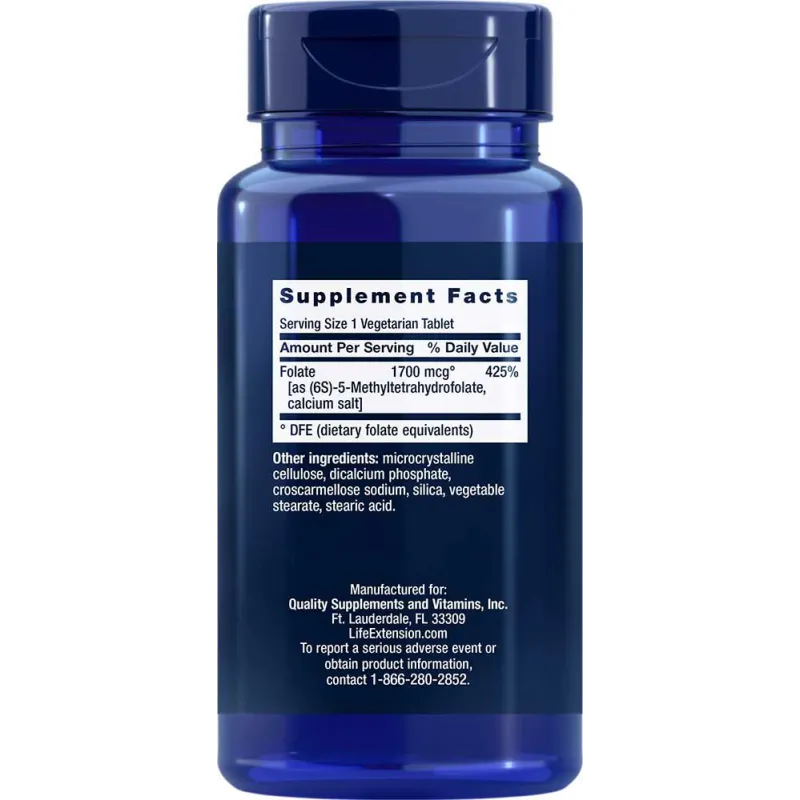
Serving Size 1 vegetarian tablet
| Amount Per Serving | |
|---|---|
| Folate [as (6S)-5-Methyltetrahydrofolate, calcium salt] | 1,700 mcg DFE |
| Other ingredients: microcrystalline cellulose, dicalcium phosphate, croscarmellose sodium, silica, vegetable stearate, stearic acid. | |
DFE (dietary folate equivalents)
Non-GMO
Dosage and Use
Take one (1) tablet daily with food, or as recommended by a healthcare practitioner.
Warnings
KEEP OUT OF REACH OF CHILDREN
DO NOT EXCEED RECOMMENDED DOSE
Do not purchase if outer seal is broken or damaged.
When using nutritional supplements, please consult with your physician if you are undergoing treatment for a medical condition or if you are pregnant or lactating.
9,48 €
8,84 €

8,99 €
28,41 €
L-methylfolate (5-MTHF) represents the bioactive form of folate that functions directly in the body without requiring conversion, offering critical advantages over synthetic folic acid used in most supplements and fortified foods. When folic acid enters the body, it must undergo enzymatic conversion through dihydrofolate reductase then methylenetetrahydrofolate reductase (MTHFR) to reach active L-methylfolate form. This conversion proves impaired in 40-60% of population carrying MTHFR genetic variants—the C677T polymorphism reduces MTHFR activity by 30-70% preventing efficient folic acid activation. For these individuals, folic acid supplementation may not effectively raise active folate levels and could accumulate as unmetabolized folic acid potentially interfering with folate metabolism. L-methylfolate bypasses all conversion steps, immediately providing biologically active folate regardless of genetic variants. Research demonstrates methylfolate produces 20-40% higher serum folate levels and superior tissue uptake compared to equivalent folic acid doses. The active form also crosses blood-brain barrier more efficiently supporting neurological folate-dependent processes.
Methylfolate plays essential role in homocysteine metabolism, converting this potentially toxic amino acid to methionine through methionine synthase enzyme requiring both methylfolate and B12 as cofactors. Elevated homocysteine above 10-15 micromol/L damages vascular endothelium, promotes oxidative stress and inflammation, and independently increases cardiovascular disease risk by 20-50%. Folate deficiency or MTHFR variants cause homocysteine accumulation affecting 30-40% of population. Methylfolate supplementation at 400-1000 mcg daily reduces homocysteine by 25-40% within 4-8 weeks, with greater reductions in individuals with MTHFR variants who poorly convert folic acid. The cardiovascular benefits extend beyond homocysteine lowering—methylfolate supports endothelial nitric oxide production improving vascular function by 15-30%, reduces oxidative stress, and supports healthy inflammatory balance. Studies show folate supplementation reduces stroke risk by 10-20% and may decrease heart attack risk, with methylfolate proving more effective than folic acid particularly in MTHFR variant carriers.
Methylfolate demonstrates remarkable psychiatric benefits as essential cofactor for neurotransmitter synthesis including serotonin, dopamine, and norepinephrine. Low folate status associates with 30-50% increased depression risk, and depressed individuals show 30-40% lower folate levels than controls. The mechanism involves methylfolate's role in BH4 (tetrahydrobiopterin) synthesis—the cofactor required for converting amino acid precursors to neurotransmitters. Methylfolate supplementation at 7.5-15 mg daily (therapeutic doses) as adjunct to antidepressants improves response rates by 30-50% in treatment-resistant depression, with MTHFR variant carriers showing greatest benefit. Even moderate doses (400-1000 mcg) improve mood scores by 15-30% in individuals with low folate status. For bipolar disorder, folate supports mood stability and may enhance medication effectiveness. Schizophrenia patients demonstrate folate deficiency rates of 50-70% with supplementation improving negative symptoms. The psychiatric effects require higher doses than cardiovascular applications, with medical-grade L-methylfolate (Deplin) using 7.5-15 mg for depression augmentation. Lower supplemental doses (400-1700 mcg DFE) provide foundational support and prevention.
Folate proves absolutely essential during pregnancy as critical cofactor for DNA synthesis and cell division—processes occurring rapidly during fetal development. Inadequate folate during early pregnancy causes neural tube defects (NTDs) including spina bifida and anencephaly affecting 1 in 1000 pregnancies without supplementation. Folic acid fortification and supplementation reduce NTD risk by 50-70%, representing one of public health's greatest successes. However, methylfolate offers advantages over folic acid for pregnancy—it provides active folate immediately without conversion requirements, proves more effective in MTHFR variant carriers (affecting 40-60% of women), and avoids potential issues with unmetabolized folic acid accumulation. Pregnancy increases folate requirements 50-100% to 600-800 mcg DFE daily to support maternal and fetal cell division, prevent megaloblastic anemia, and reduce pregnancy complications. Methylfolate also supports healthy homocysteine levels during pregnancy—elevated homocysteine associates with preeclampsia, placental abruption, and pregnancy loss. Ideally, women should begin folate supplementation 1-3 months before conception ensuring adequate status during critical early development weeks often occurring before pregnancy recognition.
Methylfolate dosing varies substantially based on application and individual needs. For general health and homocysteine reduction, 400-1000 mcg DFE daily provides adequate support for most adults. Pregnancy requires 600-800 mcg DFE daily with supplementation ideally beginning preconception. Individuals with MTHFR variants benefit from methylfolate specifically rather than folic acid, using 400-1000 mcg daily for basic needs or higher therapeutic doses for specific conditions. For depression augmentation under medical supervision, doses of 7.5-15 mg daily prove effective though require prescription-grade formulations. Taking methylfolate with food enhances tolerability though absorption occurs with or without meals. Combining with B12 (as methylcobalamin) and B6 (as P5P) proves essential as these B vitamins work synergistically in methylation and homocysteine metabolism—folate supplementation without adequate B12 can mask B12 deficiency while allowing neurological damage to progress. Monitor homocysteine at baseline and after 2-3 months supplementation aiming for levels below 10 micromol/L. For individuals with high homocysteine, combined B vitamin therapy (methylfolate, methylcobalamin, P5P) proves more effective than folate alone. The excellent safety profile supports long-term use without upper limit concerns for nutritional doses.
Results: Clinical trials demonstrate L-methylfolate produces 20-40% higher serum folate levels than folic acid with superior tissue uptake, particularly benefiting individuals with MTHFR variants affecting 40-60% of population.
Citation: Pietrzik K, et al. Br J Pharmacol. 2010 Aug;160(8):1-7.
Results: Research shows methylfolate at 400-1000 mcg daily reduces homocysteine by 25-40% within 4-8 weeks, decreases stroke risk by 10-20%, and improves endothelial function by 15-30%.
Citation: Clarke R, et al. Lancet. 2010 Jun;376(9735):1622-31.
Results: Studies reveal methylfolate augmentation of antidepressants improves response rates by 30-50% in treatment-resistant depression, with mood score improvements of 15-30% in low folate individuals.
Citation: Papakostas GI, et al. Am J Psychiatry. 2012 Dec;169(12):1267-74.
Results: Pregnancy trials show folate supplementation reduces neural tube defect risk by 50-70%, with methylfolate providing active folate immediately without conversion requirements for MTHFR variant carriers.
Citation: De-Regil LM, et al. Cochrane Database Syst Rev. 2010 Oct;(10):CD007950.