English
 Polski
 Deutsch
 Français
 ελληνικά
 Español
 Italiano
23,48 €

Quantity:
Total:
Total products:
Total shipping: To be determined
Total:
Science-based food supplements

Manufacturer: Life Extension
In stock
| Quantity | Price | You Save |
|---|---|---|
| 2 | 26,22 € | Up to 2,18 € |
| 4 | 25,67 € | Up to 6,55 € |
By buying this product you can collect up to 27 loyalty points. Your cart will total 27 points that can be converted during next order into a voucher of 1,35 €.

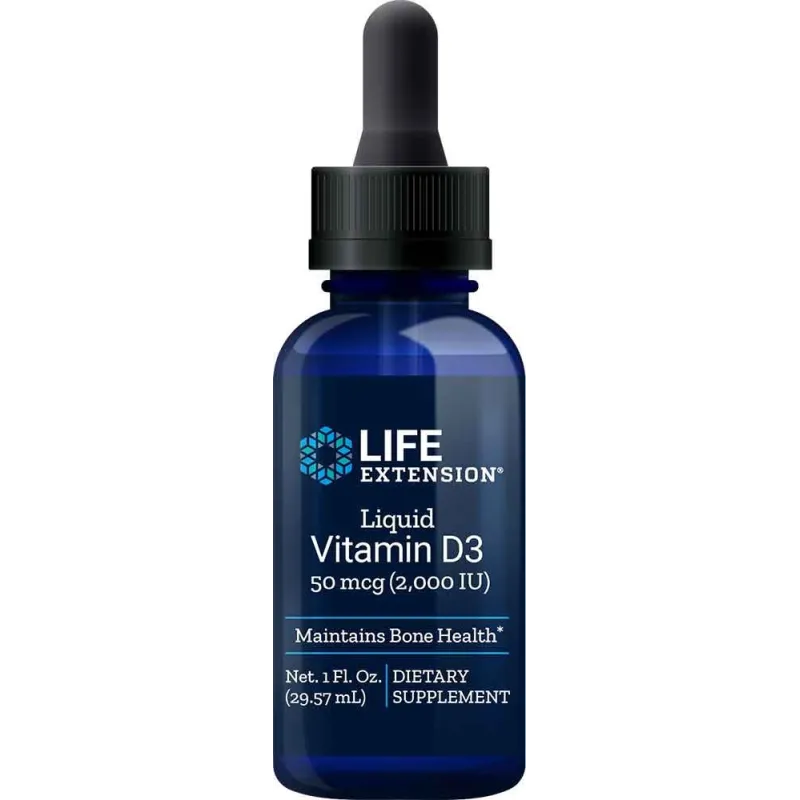
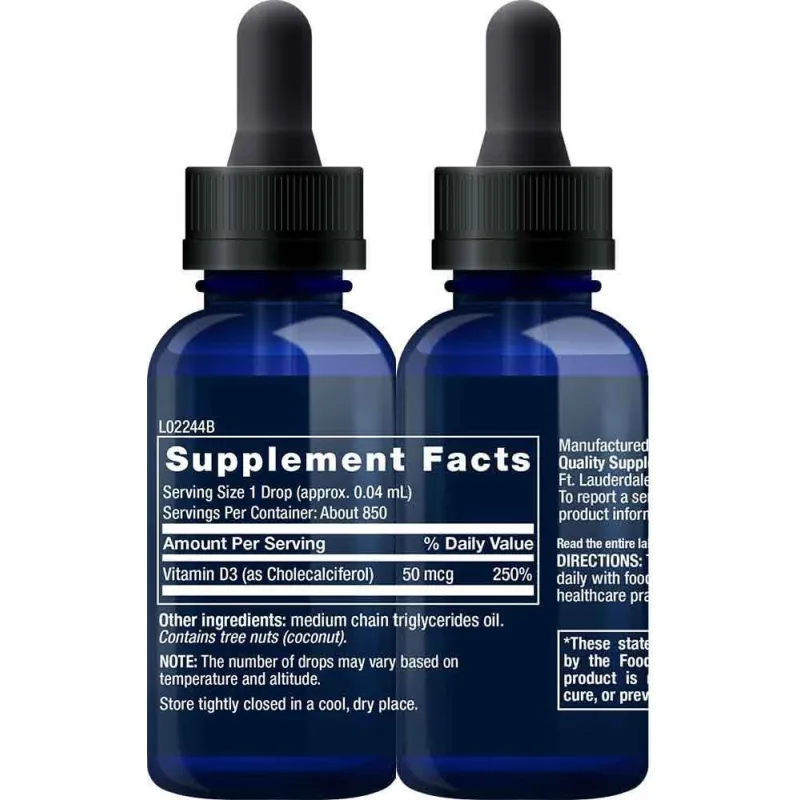
Liquid Vitamin D3
1 fl oz (29.57 ml)
Item Catalog Number: 02244
 This convenient, unflavored liquid vitamin D supplement is a great way to get your vitamin D. Maintaining healthy levels of vitamin D helps preserve youthful cognitive function and offers broad-spectrum benefits for bone and immune system health. Vitamin D also helps maintain blood pressure already within the normal range, supports healthy inflammatory response and endothelial function, and more.
Benefits at a Glance:
Your skin produces vitamin D when in direct sunlight, but you should not get your vitamin D from unprotected sun exposure or indoor tanning devices. Supplementing with vitamin D goes a long way towards inhibiting deficiency: we recommend about 5,000 IU –8,000 IU of vitamin D3 a day.
This vitamin D3 supplement delivers 2,000 IU of vitamin D3 as cholecalciferol per unflavored liquid drop. We suggest that you take a 25-hydroxy vitamin D blood test after 3 months to assess and adjust your dosage. Your optimal blood levels should be 50–80 ng/ml year-round.
Serving Size 1 drop (approx. 0.04 mL)
Servings Per Container: about 850
| Amount Per Serving | |
|---|---|
| Vitamin D3 (as Cholecalciferol) | 2000 IU |
| Other ingredients: medium chain triglycerides oil. | |
| Contains tree nuts (coconut). | |
Non-GMO
Dosage and Use
Take one (1) drop once or twice daily with food, or as recommended by a healthcare practitioner.
Note
The number of drops may vary based on temperature and altitude.
Caution
Individuals consuming more than 2,000 IU/day of vitamin D (from diet and supplements) should periodically obtain a serum 25-hydroxy vitamin D measurement. Do not exceed 10,000 IU per day unless recommended by your doctor. Vitamin D supplementation is not recommended for individuals with high blood calcium levels.
Warnings
KEEP OUT OF REACH OF CHILDREN
DO NOT EXCEED RECOMMENDED DOSE
Do not purchase if outer seal is broken or damaged.
When using nutritional supplements, please consult with your physician if you are undergoing treatment for a medical condition or if you are pregnant or lactating.
23,48 €
24,96 €

38,89 €
34,10 €
Vitamin D deficiency affects 40-60% of global population, representing one of the most prevalent nutritional deficiencies despite vitamin D's fundamental importance for health. The widespread deficiency stems from multiple converging factors. Modern indoor lifestyles drastically limit sun exposure—the primary natural vitamin D source—with office workers receiving 90% less UVB exposure than outdoor workers. Geographic latitude proves critical as people living above 35 degrees latitude (most of Europe, Canada, northern US) cannot synthesize vitamin D from November through March when sun angle prevents adequate UVB penetration. Skin pigmentation significantly impacts synthesis—melanin blocks UVB absorption, requiring darker-skinned individuals 3-6 times longer sun exposure than fair-skinned people to produce equivalent vitamin D. Aging reduces skin synthesis capacity by 50-75% as 70-year-olds produce only 25% the vitamin D of 20-year-olds from identical sun exposure. Sunscreen application, while protecting against skin damage, blocks 95-98% of vitamin D synthesis even at SPF 15. Obesity creates functional deficiency as fat-soluble vitamin D sequesters in adipose tissue reducing bioavailability by 20-50%. Dietary sources provide minimal vitamin D—fatty fish offers significant amounts but typical diets supply only 100-200 IU daily versus 1000-4000 IU needed for optimal status. Populations at highest risk include elderly individuals, those with dark skin in northern latitudes, people who are obese, individuals with malabsorption disorders, those taking certain medications, and anyone with limited sun exposure.
Liquid vitamin D3 formulations offer several practical advantages over solid dosage forms making them preferable for many users. Absorption proves superior with liquid forms as vitamin D dissolved in oil (typically medium-chain triglycerides or olive oil) provides optimal bioavailability—fat-soluble vitamin D requires dietary fat for absorption, and liquid formulations ensure this critical cofactor accompanies the vitamin. Studies show liquid vitamin D3 in oil achieves 20-30% higher blood levels compared to dry tablet formulations without oil. Dose flexibility represents a major advantage as liquids allow precise titration—users can easily adjust intake by drops rather than being limited to fixed capsule doses. This proves particularly valuable for children requiring lower doses, individuals needing high therapeutic doses, or when optimizing intake based on blood testing. Ease of administration benefits those with swallowing difficulties including elderly individuals, children, and people with dysphagia who struggle with pills. The liquid can be mixed into food or beverages without affecting efficacy. Rapid absorption occurs as liquid vitamin D doesn't require tablet dissolution, potentially reaching peak blood levels 20-30% faster. For individuals with digestive issues or malabsorption, liquid formulations bypass some absorption barriers as the pre-dissolved vitamin more readily forms micelles for intestinal uptake. The main consideration involves storage and shelf life—liquid formulations require proper storage away from heat and light to prevent degradation, though quality products in amber bottles maintain potency well.
Vitamin D functions as a steroid hormone influencing over 200 genes, producing remarkably diverse health benefits when status reaches optimal levels above 40 ng/mL. Bone health represents the classical benefit—vitamin D increases calcium absorption by 30-40% and supports bone mineralization, with deficiency causing rickets in children and osteomalacia in adults. Supplementation reduces fracture risk by 20-30% in elderly populations and increases bone density by 2-5% over 1-2 years. Immune function proves profoundly vitamin D-dependent with the vitamin enhancing innate immunity, supporting antimicrobial peptide production, and modulating adaptive immune responses. Research demonstrates 30-50% reductions in respiratory infection rates with adequate vitamin D status, particularly robust for preventing influenza and reducing COVID-19 severity. Cardiovascular benefits include 10-20% reductions in hypertension, improved endothelial function, and 15-25% lower cardiovascular disease risk with optimal status. Cancer prevention shows promise with studies suggesting 20-50% risk reductions for colorectal, breast, and other cancers associated with higher vitamin D levels. Mental health improves as vitamin D receptors throughout brain support neurotransmitter synthesis and neuroplasticity—supplementation reduces depression risk by 20-40% and improves mood scores. Autoimmune disease risk decreases 30-50% with adequate childhood vitamin D status reducing multiple sclerosis, type 1 diabetes, and other autoimmune conditions. Muscle function and fall prevention benefit from vitamin D's effects on muscle protein synthesis and neuromuscular function, with supplementation reducing falls in elderly by 20-30%.
Optimal vitamin D dosing requires individualized approach based on baseline status, body weight, and health goals, ideally guided by 25-hydroxyvitamin D blood testing. General dosing guidelines suggest 1000-2000 IU daily maintains adequate status (above 30 ng/mL) in most healthy adults, while 2000-4000 IU daily achieves optimal status (40-60 ng/mL) providing maximum health benefits. Obese individuals require 2-3 times higher doses due to sequestration in adipose tissue. Therapeutic correction of deficiency uses higher loading doses—studies show 4000-10,000 IU daily safely raises levels in deficient individuals, or single weekly doses of 50,000 IU for 8-12 weeks followed by maintenance dosing. The key principle involves that vitamin D dosing shows wide safety margin—tolerable upper limit is 4000 IU daily though research demonstrates 10,000 IU daily produces no adverse effects in most people. Toxicity requiring medical intervention proves extremely rare below 40,000 IU daily for prolonged periods. Testing strategy involves baseline 25-hydroxyvitamin D measurement before supplementation, retest after 3 months to assess response and adjust dosing, then annual monitoring to maintain optimal range. Target blood levels of 40-60 ng/mL (100-150 nmol/L) provide optimal benefits based on research, though conventional medicine often considers 30 ng/mL adequate. Taking vitamin D with largest meal of day enhances absorption by 50% compared to fasted state. Combining with vitamin K2 (100-200 mcg daily) proves important as K2 directs calcium deposited through vitamin D-enhanced absorption into bones rather than soft tissues. Magnesium adequacy (300-400 mg daily) supports vitamin D metabolism as magnesium serves as cofactor for vitamin D activation.
Vitamin D demonstrates excellent safety profile at recommended doses with toxicity proving rare and occurring only at very high prolonged intake. The tolerable upper limit of 4000 IU daily provides substantial safety margin as research shows 10,000 IU daily produces no adverse effects in most individuals. True vitamin D toxicity (hypervitaminosis D) requires sustained intake exceeding 40,000-100,000 IU daily for months, presenting with hypercalcemia causing nausea, weakness, kidney problems, and calcification of soft tissues. Monitoring proves prudent at doses above 10,000 IU daily through periodic blood testing of 25-hydroxyvitamin D and calcium levels. Several medication interactions warrant attention: vitamin D may reduce effectiveness of certain cholesterol medications, while thiazide diuretics combined with high-dose vitamin D increase hypercalcemia risk requiring monitoring. Individuals with sarcoidosis, hyperparathyroidism, or other conditions causing hypercalcemia should avoid supplementation without medical supervision as vitamin D may worsen calcium elevation. People with kidney disease require physician guidance as impaired vitamin D activation and calcium metabolism necessitate specialized dosing. The most important co-supplementation involves vitamin K2—as vitamin D increases calcium absorption, K2 ensures proper calcium utilization in bones rather than arteries. Taking 100-200 mcg vitamin K2 daily with vitamin D provides this protection. Magnesium proves essential as vitamin D metabolism requires magnesium, with some individuals experiencing muscle cramps or other magnesium deficiency symptoms when starting vitamin D without adequate magnesium intake. Most healthy individuals tolerate 2000-5000 IU daily vitamin D3 excellently with minimal monitoring required.
Results: Clinical trials demonstrate vitamin D supplementation at 2000-4000 IU daily achieves optimal blood levels of 40-60 ng/mL, reduces fracture risk by 20-30% in elderly, and decreases falls by 20-30% through improved muscle and neuromuscular function.
Citation: Bischoff-Ferrari HA, et al. JAMA. 2005 May;293(18):2257-64.
Results: Research shows adequate vitamin D status reduces respiratory infection rates by 30-50%, with meta-analyses confirming 10-50% reductions in acute respiratory infections through enhanced immune function and antimicrobial peptide production.
Citation: Martineau AR, et al. BMJ. 2017 Feb;356:i6583.
Results: Studies reveal liquid vitamin D3 in oil achieves 20-30% higher blood levels compared to dry tablet formulations, with absorption enhanced 50% when taken with meals containing dietary fat.
Citation: Grossmann RE, et al. Nutrients. 2010 Jul;2(7):693-724.
Results: Cardiovascular trials show optimal vitamin D status reduces hypertension risk by 10-20%, improves endothelial function, and decreases cardiovascular disease risk by 15-25% through multiple protective mechanisms.
Citation: Pilz S, et al. Nat Rev Cardiol. 2016 Jul;13(7):404-17.