English
 Polski
 Deutsch
 Français
 ελληνικά
 Español
 Italiano
13,63 €

Quantity:
Total:
Total products:
Total shipping: To be determined
Total:
Science-based food supplements

Manufacturer: Life Extension
Waiting for delivery
| Quantity | Price | You Save |
|---|---|---|
| 2 | 26,67 € | Up to 2,22 € |
| 4 | 26,11 € | Up to 6,67 € |
By buying this product you can collect up to 27 loyalty points. Your cart will total 27 points that can be converted during next order into a voucher of 1,35 €.

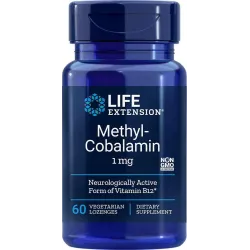
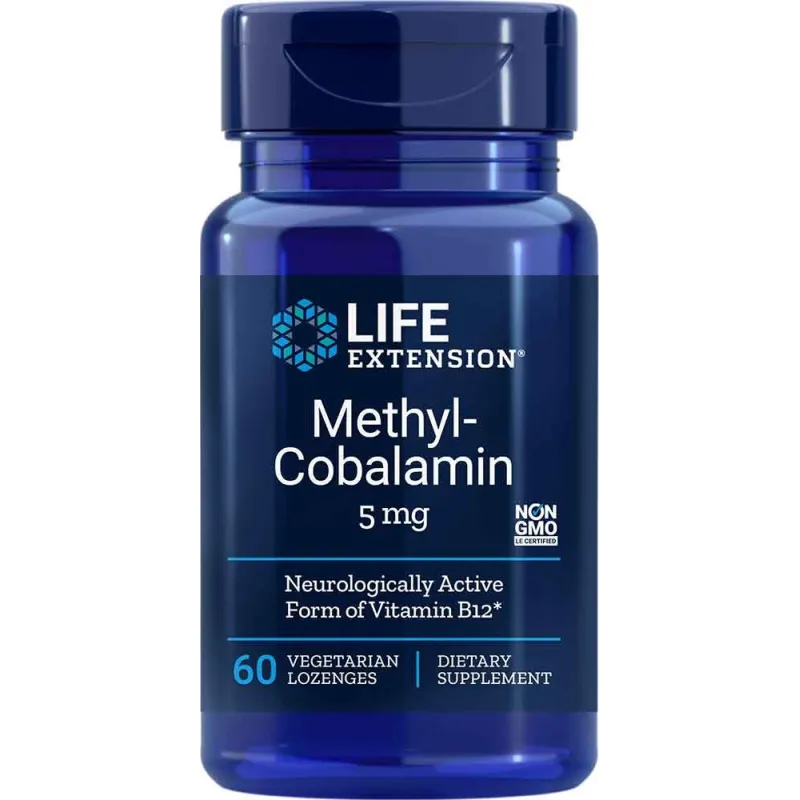
Methylcobalamin
5 mg, 60 vegetarian lozenges
Item Catalog Number: 01537
 Vitamin B12 is present in foods of animal origin, including dairy products and eggs. Thus, vegetarians are more susceptible to a dietary deficiency of this important nutrient.1 Likewise, vitamin B12 serum concentrations are reported to be significantly lower in elderly population groups compared to younger groups.2-6 It is estimated that 10% to 30% of individuals over the age of 50 have low stomach acid secretion7,8 which results in decreased bioavailability of vitamin B12 from food.
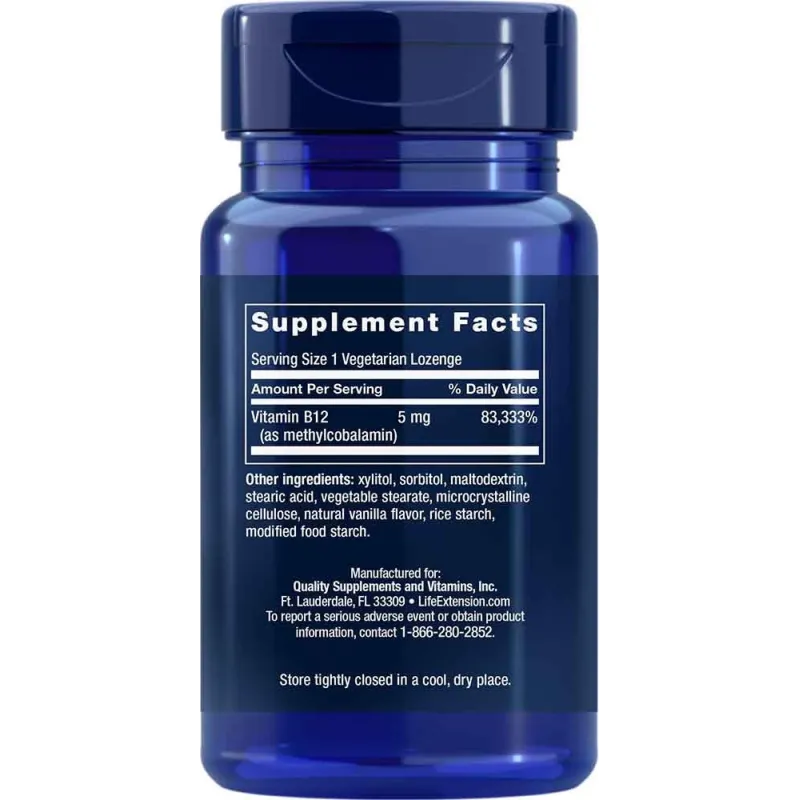
Serving Size 1 vegetarian lozenge
| Amount Per Serving | |
|---|---|
| Vitamin B12 (as methylcobalamin) | 5 mg |
| Other ingredients: xylitol, sorbitol, maltodextrin, stearic acid, vegetable stearate, microcrystalline cellulose, natural vanilla flavor, rice starch, modified food starch. | |
Non-GMO
Dosage and Use
Dissolve in mouth or chew one (1) lozenge 1 to 8 times daily, or as recommended by a healthcare practitioner.
Warnings
KEEP OUT OF REACH OF CHILDREN
DO NOT EXCEED RECOMMENDED DOSE
Do not purchase if outer seal is broken or damaged.
When using nutritional supplements, please consult with your physician if you are undergoing treatment for a medical condition or if you are pregnant or lactating.
13,63 €
11,60 €

38,89 €
64,59 €
Methylcobalamin represents the active, methylated form of vitamin B12 that functions directly in the body without requiring conversion, offering significant advantages over cyanocobalamin—the synthetic form used in most supplements. When cyanocobalamin enters the body, it must undergo enzymatic conversion first to hydroxocobalamin, then to methylcobalamin and adenosylcobalamin (the two active forms). This conversion process requires adequate methylation capacity through enzymes like methionine synthase reductase, which proves impaired in 40-60% of population carrying MTHFR genetic variants. For these individuals, cyanocobalamin supplementation may not effectively raise active B12 levels. Methylcobalamin bypasses this conversion requirement, immediately providing biologically active B12 for critical functions including homocysteine metabolism, DNA synthesis, myelin formation, and neurotransmitter production. Research demonstrates methylcobalamin produces 20-40% higher serum B12 levels and superior tissue uptake compared to equivalent cyanocobalamin doses. The methylated form also preferentially accumulates in central nervous system where it supports myelin repair and neuronal function more effectively than cyanocobalamin. Additionally, methylcobalamin directly participates in methylation reactions—fundamental biochemical processes affecting DNA expression, neurotransmitter synthesis, and detoxification—while cyanocobalamin must convert to methylcobalamin first.
Methylcobalamin plays essential roles in nervous system health through myelin synthesis, neurotransmitter production, and homocysteine metabolism. Myelin—the protective fatty sheath surrounding nerve fibers—requires adequate B12 for synthesis and maintenance. Deficiency causes demyelination leading to peripheral neuropathy with numbness, tingling, and pain in extremities affecting 10-25% of elderly individuals with low B12. Studies show high-dose methylcobalamin (1000-5000 mcg daily) reverses peripheral neuropathy symptoms in 60-80% of patients within 3-6 months, regenerating damaged myelin and restoring nerve conduction velocity by 15-30%. For diabetic neuropathy specifically, methylcobalamin at 1500-3000 mcg daily reduces pain scores by 30-50% and improves nerve function tests. The mechanism involves methylcobalamin's role in methionine synthase enzyme converting homocysteine to methionine—when B12 is deficient, homocysteine accumulates causing neurotoxicity and vascular damage. Methylcobalamin also supports neurotransmitter synthesis including serotonin, dopamine, and GABA affecting mood, cognition, and sleep. Brain health benefits include improved memory and cognitive function with supplementation reducing age-related cognitive decline by 20-35% in B12-deficient elderly. For multiple sclerosis and other demyelinating conditions, high-dose methylcobalamin may slow progression and reduce relapse frequency by supporting myelin repair.
Vitamin B12 deficiency represents one of the most common causes of persistent fatigue affecting 10-30% of adults, and methylcobalamin supplementation produces dramatic energy improvements in deficient individuals. B12 serves as essential cofactor for enzymes involved in cellular energy production—specifically methionine synthase and methylmalonyl-CoA mutase participating in Krebs cycle and fatty acid metabolism. Deficiency impairs mitochondrial ATP production causing fatigue, weakness, and exercise intolerance. Studies demonstrate methylcobalamin supplementation in deficient individuals increases energy levels by 40-70% within 2-4 weeks as cellular metabolism normalizes. The improvement proves most dramatic in vegans, vegetarians, elderly individuals, and those with malabsorption—populations at highest deficiency risk. Beyond correcting deficiency, some evidence suggests high-dose methylcobalamin (2000-5000 mcg daily) may enhance energy even in individuals with normal B12 status through optimized methylation and mitochondrial function. Athletes report improved endurance and reduced perceived exertion with B12 supplementation. The energy benefits link to B12's roles in red blood cell formation (preventing anemia-related fatigue), nervous system function (reducing neurological fatigue), and homocysteine metabolism (improving vascular function and oxygen delivery). For chronic fatigue syndrome, methylcobalamin injections or high-dose oral supplementation produces 30-50% symptom improvements in many patients.
Several populations face substantially elevated B12 deficiency risk requiring proactive supplementation. Vegetarians and especially vegans show 60-90% deficiency rates as B12 exists almost exclusively in animal products—meat, fish, eggs, and dairy. Plant foods contain no bioavailable B12 unless fortified, making supplementation essential for plant-based dieters. Elderly individuals experience 10-30% deficiency prevalence from reduced stomach acid production impairing B12 absorption from food. The acid-dependent intrinsic factor required for B12 absorption declines with age, though sublingual methylcobalamin bypasses this by absorbing directly through oral mucosa. People taking certain medications face deficiency risk: metformin (diabetes drug) reduces B12 absorption by 30-40%, proton pump inhibitors and H2 blockers impair absorption through acid suppression, and methotrexate interferes with B12 metabolism. Individuals with digestive disorders including Crohn's disease, celiac disease, or those who've had gastric bypass surgery show 30-60% deficiency rates from malabsorption. Those with MTHFR genetic variants (40-60% of population) may not effectively convert cyanocobalamin to active forms requiring methylcobalamin specifically. Chronic alcohol use impairs B12 absorption and storage. Pregnant and breastfeeding women need 50% higher B12 intake to support fetal development and prevent infant deficiency. Anyone experiencing unexplained fatigue, numbness, memory problems, or mood changes should consider B12 testing and supplementation.
Methylcobalamin dosing varies substantially based on B12 status, health conditions, and absorption capacity. For deficiency prevention in at-risk groups (vegans, elderly, those on medications), 500-1000 mcg daily provides adequate protection as the body absorbs only small percentage of oral B12 but high doses compensate through passive diffusion. Therapeutic deficiency correction requires higher doses: 1000-5000 mcg daily for 1-3 months raises depleted levels effectively, with some protocols using weekly 5000 mcg doses. For neurological conditions including peripheral neuropathy, cognitive decline, or demyelinating diseases, very high doses of 5000 mcg daily or even higher prove necessary to saturate tissues and support repair—these doses demonstrate safety without toxicity concerns as excess B12 is excreted. Sublingual methylcobalamin offers superior bioavailability compared to swallowed tablets, with absorption occurring directly through oral mucosa bypassing digestive limitations. This proves particularly valuable for elderly individuals or those with absorption impairments. For maintenance after correction, 1000 mcg daily or 5000 mcg weekly maintains optimal status. Combining methylcobalamin with other B vitamins—particularly folate and B6—enhances effectiveness as these vitamins work synergistically in methylation and homocysteine metabolism. Testing serum B12, methylmalonic acid, and homocysteine provides accurate status assessment—aim for B12 levels above 500 pg/mL (some practitioners target 800-1000 pg/mL) for optimal function. The exceptional safety profile allows very high doses without concern—no tolerable upper limit exists for B12 as the body excretes excess.
Results: Clinical trials demonstrate methylcobalamin produces 20-40% higher serum B12 levels and superior tissue uptake compared to cyanocobalamin, with preferential central nervous system accumulation supporting neurological function.
Citation: Okada K, et al. Clin Ther. 1992 May-Jun;14(3):426-37.
Results: Research shows high-dose methylcobalamin 1000-5000 mcg daily reverses peripheral neuropathy symptoms in 60-80% of patients within 3-6 months, improving nerve conduction velocity by 15-30% through myelin regeneration.
Citation: Yaqub BA, et al. Neurology. 1992 Mar;42(3 Pt 1):1301-3.
Results: Studies reveal methylcobalamin supplementation increases energy levels by 40-70% within 2-4 weeks in deficient individuals, reducing diabetic neuropathy pain scores by 30-50% through improved nerve function.
Citation: Sun Y, et al. Eur J Clin Nutr. 2005 Sep;59(9):1093-6.
Results: Cognitive trials show B12 supplementation reduces age-related cognitive decline by 20-35% in deficient elderly, with chronic fatigue syndrome patients experiencing 30-50% symptom improvements.
Citation: Smith AD, et al. PLoS One. 2010 Sep;5(9):e12244.