English
 Polski
 Deutsch
 Français
 ελληνικά
 Español
 Italiano

13,63 €

Quantity:
Total:
Total products:
Total shipping: To be determined
Total:
Science-based food supplements

Manufacturer: Life Extension
In stock
| Quantity | Price | You Save |
|---|---|---|
| 2 | 7,70 € | Up to 0,64 € |
| 4 | 7,54 € | Up to 1,92 € |
By buying this product you can collect up to 8 loyalty points. Your cart will total 8 points that can be converted during next order into a voucher of 0,40 €.

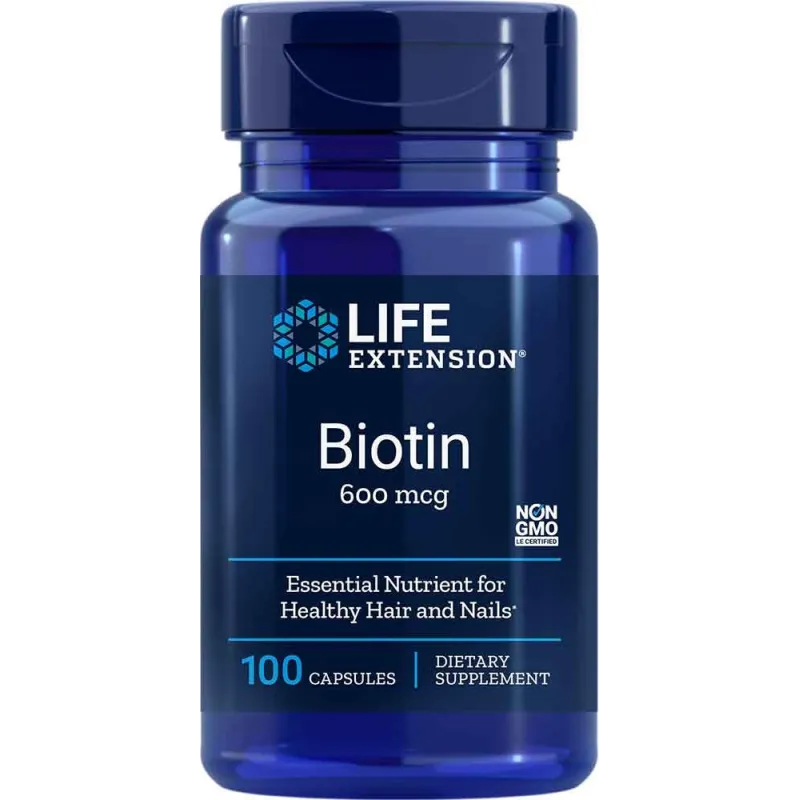
Biotin
600 mcg, 100 capsules
Item Catalog Number: 00102
 Biotin is an unnumbered member of the water soluble B-complex family, normally only required in minute amounts. Biotin is used as a cofactor of enzymes involved in fatty acid metabolism, gluconeogenesis, and amino acid catabolism, and is essential in maintaining metabolic homeostasis.1-4 Biotin plays an important role in metabolic functioning as a coenzyme carrier of activated carbon dioxide in the TCA cycle (also known as the Krebs cycle).3-7 In its coenzyme form, biotin synthesizes glucose from non-carbohydrate sources, and synthesizes and breaks down certain fatty acids and amino acids.4-7
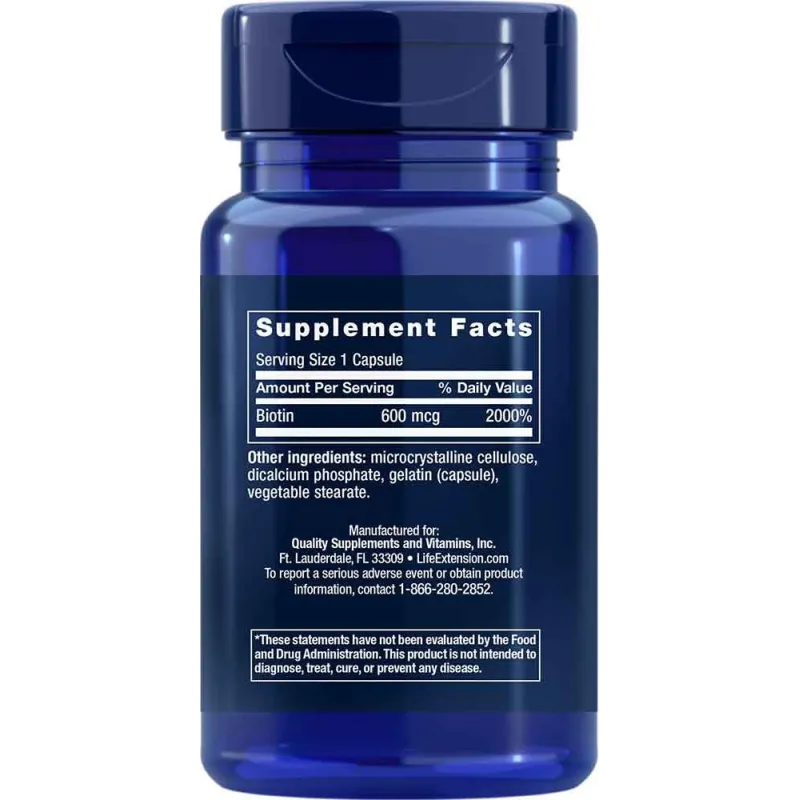
Serving Size 1 capsule
| Amount Per Serving | |
|---|---|
| Biotin | 600 mcg |
| Other ingredients: rice flour, gelatin, vegetable stearate. | |
Non-GMO
Dosage and Use
Take one (1) capsule daily with meals, or as recommended by a healthcare practitioner.
Warnings
KEEP OUT OF REACH OF CHILDREN
DO NOT EXCEED RECOMMENDED DOSE
Do not purchase if outer seal is broken or damaged.
When using nutritional supplements, please consult with your physician if you are undergoing treatment for a medical condition or if you are pregnant or lactating.
Used as a cofactor of enzymes involved in fatty acid metabolism, gluconeogenesis, and amino acid catabolism. Essential in maintaining metabolic homeostasis
Biotin is an unnumbered member of the water soluble B-complex family, normally only required in minute amounts. Biotin is used as a cofactor of enzymes involved in fatty acid metabolism, gluconeogenesis, and amino acid catabolism, and is essential in maintaining metabolic homeostasis. Biotin plays an important role in metabolic functioning as a coenzyme carrier of activated carbon dioxide in the TCA cycle (also known as the Krebs cycle). In its coenzyme form, biotin synthesizes glucose from non-carbohydrate sources, and synthesizes and breaks down certain fatty acids and amino acids.







Biotin (vitamin B7 or vitamin H) serves as an essential cofactor for five carboxylase enzymes catalyzing critical metabolic reactions including fatty acid synthesis, amino acid catabolism, and gluconeogenesis. Its name derives from the Greek "bios" meaning life, reflecting its fundamental metabolic importance. For hair, skin, and nails specifically, biotin supports keratin infrastructure—the structural protein comprising 95% of hair, the primary component of nails, and a major constituent of epidermis. Biotin deficiency, though rare, produces distinctive symptoms: hair thinning and loss, brittle nails with longitudinal ridging, and characteristic seborrheic dermatitis with scaly red rash around eyes, nose, and mouth. These symptoms resolve with biotin supplementation at 30-100 mcg daily (the adequate intake level), validating biotin's structural role. However, therapeutic supplementation at 2500-10,000 mcg targets improved hair, skin, and nail quality even in biotin-sufficient individuals. Research demonstrates biotin enhances keratin synthesis through upregulation of keratin genes and improves follicle cell proliferation. Clinical trials show 5000-10,000 mcg daily increases nail thickness by 25% and reduces brittleness by 45% after 6-9 months. For hair, biotin supplementation produces measurable improvements in individuals with underlying deficiency or marginal status, though benefits in biotin-replete individuals remain debated.
The adequate intake for biotin is remarkably low—30 mcg daily for adults—with deficiency rare due to biotin's presence in diverse foods and bacterial synthesis in the colon. However, therapeutic supplementation for hair, skin, and nails utilizes doses 80-330 times higher: 2500-10,000 mcg daily. These supraphysiological doses aim to saturate biotin-dependent enzymes and maximize keratin synthesis beyond what normal dietary intake provides. Clinical trials demonstrating hair and nail benefits typically use 2500-5000 mcg for general improvement and 5000-10,000 mcg for more significant results, particularly in individuals with brittle nails or thinning hair. Biotin demonstrates exceptional safety—no tolerable upper intake level has been established because biotin exhibits virtually no toxicity even at very high doses. Excess biotin is simply excreted in urine due to water solubility. Studies using 200,000-300,000 mcg (200-300 mg) show no adverse effects beyond occasional mild digestive upset. The primary concern with high-dose biotin involves laboratory test interference—biotin can cause falsely elevated or depressed results in immunoassays using biotin-streptavidin technology, particularly affecting thyroid function tests, cardiac troponin, vitamin D, and hormone panels. This interference can lead to misdiagnosis, so individuals taking high-dose biotin should inform healthcare providers and laboratories, typically discontinuing supplementation 48-72 hours before testing.
The evidence base for biotin's cosmetic benefits shows interesting patterns—strong support for nail health, moderate evidence for hair improvement in deficiency states, and limited data for hair benefits in biotin-sufficient individuals. For nails, multiple clinical trials demonstrate clear benefits: supplementation with 2500 mcg daily increases nail plate thickness by 25% after 6-9 months, with 63-91% of participants showing improvement in nail firmness and reduced splitting. Electron microscopy reveals improved nail matrix organization and increased keratin density. These nail benefits appear consistent across studies. For hair, the evidence proves more nuanced. In individuals with documented biotin deficiency (rare in developed countries), supplementation produces dramatic hair regrowth and quality improvements. Case reports show significant restoration of hair in deficiency-associated alopecia. However, placebo-controlled trials in biotin-sufficient individuals yield mixed results. Some studies show modest improvements in hair quality and growth rate with 5000-10,000 mcg daily, while others find no significant difference versus placebo. Meta-analyses conclude biotin likely benefits hair growth in those with marginal biotin status, underlying metabolic issues affecting biotin utilization, or specific hair/nail disorders like uncombable hair syndrome or brittle nail syndrome, but benefits in individuals with normal biotin status and typical age-related hair thinning remain uncertain. The popularity of biotin for hair often exceeds current scientific evidence, though low toxicity risk makes trials reasonable.
While overt biotin deficiency remains rare, several populations demonstrate increased risk of inadequate status or impaired biotin metabolism potentially benefiting from supplementation. Pregnant and lactating women show decreased biotin status—up to 50% of pregnant women demonstrate marginal biotin deficiency evidenced by increased urinary biotin metabolites, possibly contributing to pregnancy-related hair changes and nail brittleness. Individuals with biotinidase deficiency, a genetic disorder affecting 1 in 60,000 births, cannot recycle biotin efficiently, requiring high-dose supplementation (5000-20,000 mcg) lifelong. People consuming raw egg whites regularly face biotin depletion—raw egg white contains avidin, a protein binding biotin tightly and preventing absorption. Chronic alcohol consumption impairs biotin absorption and utilization. Individuals on long-term anticonvulsants (particularly carbamazepine, phenytoin, phenobarbital) experience accelerated biotin catabolism, potentially requiring supplementation. Those with inflammatory bowel disease or previous gastric surgery may have impaired absorption. Smokers show reduced biotin status compared to non-smokers. People on long-term antibiotics face reduced colonic bacterial biotin synthesis. Individuals with seborrheic dermatitis or other dermatological conditions often show suboptimal biotin status. These at-risk groups may experience more consistent benefits from biotin supplementation compared to the general population with adequate biotin status.
Therapeutic biotin supplementation for hair, skin, and nails typically utilizes 2500-10,000 mcg daily, with specific dosing depending on goals and severity of concerns. For general hair, skin, and nail support, 2500-5000 mcg daily provides reasonable coverage for most individuals. Those with more significant concerns—severe brittle nails, notable hair thinning, or at-risk status—may benefit from 5000-10,000 mcg daily. The timing requires patience as keratin-based tissues grow slowly: nails grow approximately 3mm monthly, requiring 6-9 months for complete nail plate replacement where thickness and strength improvements become fully apparent. Hair grows 12-15cm annually (1-1.5cm monthly), meaning 3-4 months minimum before noticing changes, with optimal assessment requiring 6-12 months. Skin improvements may emerge more rapidly (4-8 weeks) due to faster epidermal turnover. Taking biotin with food may reduce mild digestive effects some experience, though absorption occurs efficiently with or without meals. Combining biotin with other hair/nail-supporting nutrients (silica, zinc, iron, vitamin C, amino acids) may provide synergistic benefits through complementary mechanisms. Remember to inform healthcare providers about biotin supplementation before laboratory testing and discontinue 48-72 hours before blood work to prevent test interference. The excellent safety profile supports long-term continuous use without cycling requirements, making biotin suitable for ongoing cosmetic support.
Results: Clinical trials demonstrate biotin supplementation at 2500 mcg daily increases nail plate thickness by 25% after 6-9 months, with 63-91% of participants showing improvement in nail firmness and reduced splitting measured by clinical assessment and electron microscopy.
Citation: Colombo VE, et al. J Am Acad Dermatol. 1990 Dec;23(6 Pt 1):1127-32.
Results: Research shows biotin upregulates keratin gene expression in hair follicle cells, enhances follicle cell proliferation, and improves hair quality in individuals with marginal biotin status or underlying metabolic issues affecting biotin utilization.
Citation: Patel DP, et al. Skin Appendage Disord. 2017 Aug;3(3):166-9.
Results: Studies reveal high-dose biotin 5000-10,000 mcg daily demonstrates excellent safety with no established tolerable upper limit, though can cause false laboratory results requiring 48-72 hour discontinuation before testing to prevent immunoassay interference.
Citation: Piketty ML, et al. Clin Chem Lab Med. 2017 May;55(6):817-25.
Results: Nail matrix imaging shows biotin supplementation improves nail plate organization, increases keratin density, and reduces nail brittleness with effects becoming measurable after 6 months of consistent 2500-5000 mcg daily supplementation.
Citation: Hochman LG, et al. Cutis. 1993 Apr;51(4):303-5.