 English
 Polski
 Deutsch
 Français
 ελληνικά
 Español
 Italiano

14,45 €

Quantity:
Total:
Total products:
Total shipping: To be determined
Total:
Science-based food supplements

Manufacturer: Life Extension
In stock
| Quantity | Price | You Save |
|---|---|---|
| 2 | 13,93 € | Up to 1,16 € |
| 4 | 13,64 € | Up to 3,48 € |
By buying this product you can collect up to 14 loyalty points. Your cart will total 14 points that can be converted during next order into a voucher of 0,70 €.

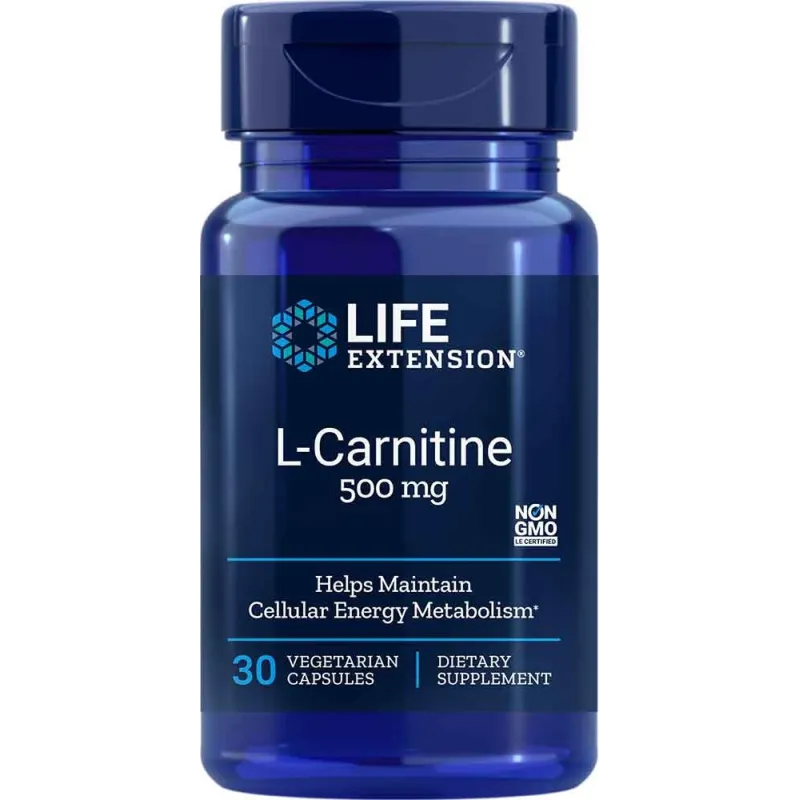
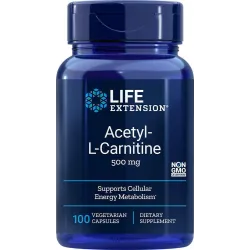
L-Carnitine
500 mg, 30 vegetarian capsules
Item Catalog Number: 01532
 Mitochondria, the powerhouses found within human cells, produce the energy that vital tissues need to keep us vibrant, healthy, and young.1 Normal levels of carnitine support the optimum functioning of mitochondria. The problem is that over time, levels of carnitine decline in all of our tissues,2,3 reducing cellular energy production, and metabolic activity.4-10 The answer is carnitine supplementation because carnitine helps:
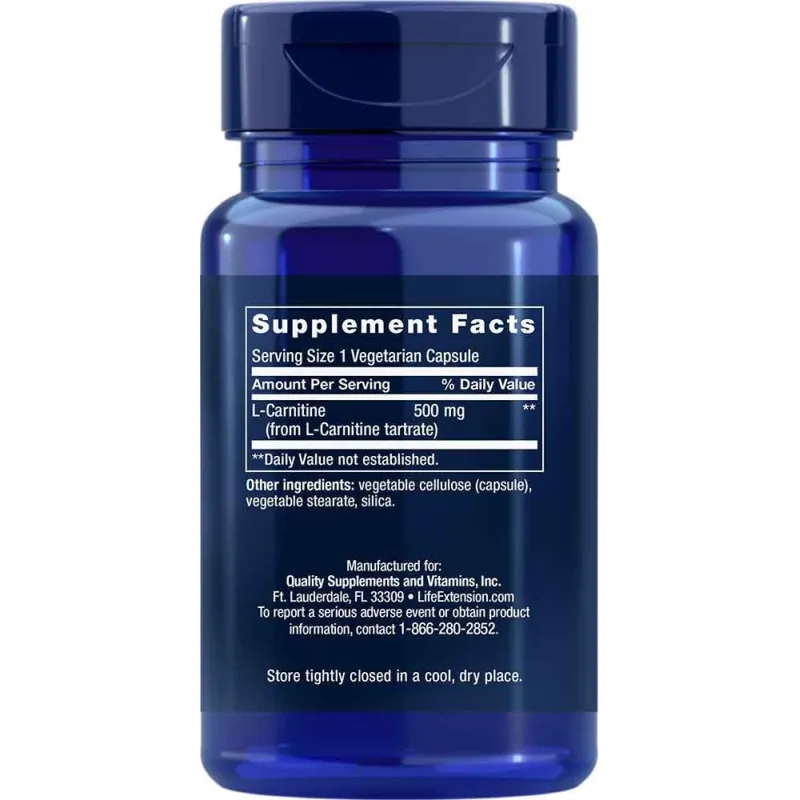
Serving Size 1 vegetarian capsule
| Amount Per Serving | |
|---|---|
| L-Carnitine (from L-Carnitine tartrate) | 500 mg |
| Other ingredients: vegetable cellulose (capsule), dicalcium phosphate, vegetable stearate, silica. | |
Non-GMO
Dosage and Use
Take one (1) capsule on an empty stomach not exceeding four (4) capsules daily, or as recommended by a healthcare practitioner.
Warnings
KEEP OUT OF REACH OF CHILDREN
DO NOT EXCEED RECOMMENDED DOSE
Do not purchase if outer seal is broken or damaged.
When using nutritional supplements, please consult with your physician if you are undergoing treatment for a medical condition or if you are pregnant or lactating.
14,45 €
12,56 €

13,63 €

13,08 €







L-carnitine is a quaternary ammonium compound synthesized from lysine and methionine that plays an essential role in cellular energy production. Its primary function involves transporting long-chain fatty acids across the mitochondrial membrane where they undergo beta-oxidation generating ATP. Without adequate carnitine, fatty acids cannot enter mitochondria efficiently, impairing fat metabolism and energy production. While the body produces carnitine endogenously and obtains it from diet (particularly red meat), certain populations benefit from supplementation: vegetarians and vegans with minimal dietary intake, elderly individuals with declining synthesis (carnitine production decreases 10-15% per decade after 40), people with genetic carnitine deficiency, and those with increased demands from intense exercise or metabolic stress. Research demonstrates carnitine supplementation at 500-2000 mg daily increases muscle carnitine content by 10-20% over weeks to months, enhancing fat oxidation capacity by 15-30%. This metabolic shift proves particularly valuable during caloric restriction or exercise where efficient fat utilization supports energy availability while sparing muscle glycogen.
L-carnitine's ergogenic benefits stem from enhanced fat metabolism, reduced muscle damage, and improved recovery processes. By increasing fatty acid oxidation, carnitine spares muscle glycogen allowing longer sustained effort before glycogen depletion—studies show 10-25% improvements in endurance performance particularly during prolonged exercise exceeding 60 minutes. The compound also reduces exercise-induced muscle damage measured by 20-40% lower creatine kinase and lactate dehydrogenase levels post-exercise, indicating less muscle fiber disruption. This translates to reduced muscle soreness and faster recovery between training sessions. Carnitine supplementation demonstrates anti-fatigue effects reducing perceived exertion and extending time to exhaustion by 10-20% in controlled trials. For recovery, carnitine accelerates muscle repair and reduces markers of oxidative stress by 25-35%. Some research suggests carnitine enhances exercise-induced adaptations by improving mitochondrial biogenesis and muscle capillary density. Optimal athletic dosing uses 2-3 grams daily, preferably combined with carbohydrates which enhance muscle carnitine uptake through insulin-mediated transport. Effects develop progressively requiring 2-3 months of consistent supplementation to maximize muscle carnitine content and performance benefits.
L-carnitine's role in fatty acid transport positions it as a potential weight loss aid, though research shows modest effects requiring realistic expectations. By enhancing mitochondrial fat oxidation, carnitine theoretically increases fat burning—studies demonstrate 15-30% higher fat oxidation rates during exercise with supplementation. However, weight loss trials show variable results: meta-analyses reveal average weight loss of 1-2.5 kg over 8-12 weeks versus placebo, a meaningful but modest benefit. The effects prove most pronounced when combined with caloric restriction and exercise rather than supplementation alone without lifestyle modification. Carnitine appears particularly beneficial for individuals with low baseline carnitine status (vegetarians, elderly) who may experience more robust fat metabolism improvements. The mechanism extends beyond simple fat transport—carnitine reduces fatigue enabling longer or more intense exercise sessions, potentially increasing total energy expenditure. Some research suggests carnitine may reduce hunger and improve satiety scores by 10-20% supporting dietary adherence. For body composition, carnitine supplementation combined with resistance training may preferentially preserve lean mass while losing fat, though evidence remains preliminary. Realistic expectations involve viewing carnitine as supportive tool enhancing metabolic flexibility and exercise capacity rather than standalone fat loss solution.
Beyond athletic applications, L-carnitine demonstrates significant cardiovascular and metabolic benefits supported by clinical research. For heart health, carnitine improves cardiac energy metabolism—the heart relies heavily on fatty acid oxidation requiring abundant carnitine. Studies in heart failure patients show carnitine supplementation at 2-3 grams daily improves exercise capacity by 15-25%, reduces symptoms, and may improve survival. Following heart attack, carnitine reduces infarct size, improves left ventricular function, and decreases arrhythmia incidence by 30-50%. The compound also supports peripheral vascular disease with studies showing 75% improvement in walking distance in claudication patients. For metabolic health, carnitine enhances insulin sensitivity improving glucose uptake by 10-20% and reducing fasting glucose in insulin-resistant individuals. Lipid profiles improve with 10-15% reductions in triglycerides and modest LDL decreases. The anti-inflammatory effects prove valuable with carnitine reducing inflammatory markers CRP and IL-6 by 20-35%. For diabetics, carnitine may reduce neuropathy symptoms and improve glycemic control. Brain health benefits include neuroprotection through enhanced neuronal energy metabolism, with research suggesting improvements in age-related cognitive decline and possibly Alzheimer's disease progression. These diverse benefits reflect carnitine's fundamental role in cellular energy production affecting multiple organ systems.
Effective L-carnitine supplementation requires attention to dose, form, timing, and duration. For general health and metabolism support, 500-1000 mg daily provides meaningful benefits. Athletic performance and recovery applications use 2-3 grams daily divided into 2-3 doses. Cardiovascular therapeutic applications employ 2-3 grams daily under medical supervision. L-carnitine L-tartrate represents the most common and well-studied form with good bioavailability and tolerability. Acetyl-L-carnitine (ALCAR) crosses the blood-brain barrier more effectively, making it preferable for cognitive applications at 500-1500 mg daily. Propionyl-L-carnitine shows particular benefit for peripheral vascular disease. Taking carnitine with carbohydrates enhances muscle uptake—consuming with meals containing 30-80 grams carbohydrates optimizes insulin-mediated transport. For athletes, taking 1-2 grams with pre-workout meal and 1 gram post-workout maximizes performance and recovery benefits. Effects develop slowly requiring patience—muscle carnitine loading takes 8-12 weeks to plateau, meaning performance benefits emerge progressively over 2-3 months. The excellent safety profile supports long-term continuous use without cycling requirements. Side effects prove rare and mild, occasionally including digestive upset or fishy body odor at very high doses (>3 grams daily), resolved by dose reduction. People on thyroid medication should monitor thyroid function as carnitine may interfere with thyroid hormone action.
Results: Clinical trials demonstrate L-carnitine supplementation at 2-3 grams daily increases muscle carnitine by 10-20%, enhances fat oxidation by 15-30%, and improves endurance performance by 10-25% particularly during prolonged exercise.
Citation: Wall BT, et al. J Physiol. 2011 Feb;589(Pt 4):963-73.
Results: Research shows carnitine reduces exercise-induced muscle damage by 20-40%, decreases creatine kinase and lactate markers, and extends time to exhaustion by 10-20% with reduced perceived exertion.
Citation: Fielding R, et al. Amino Acids. 2018 Feb;50(2):249-259.
Results: Meta-analyses reveal carnitine supplementation produces 1-2.5 kg additional weight loss over 8-12 weeks versus placebo with enhanced fat oxidation rates of 15-30% during exercise.
Citation: Pooyandjoo M, et al. Obes Rev. 2016 Oct;17(10):970-6.
Results: Cardiovascular trials show carnitine improves heart failure exercise capacity by 15-25%, reduces post-heart attack arrhythmias by 30-50%, and enhances insulin sensitivity with 10-20% better glucose uptake.
Citation: DiNicolantonio JJ, et al. Mayo Clin Proc. 2013 May;88(5):544-51.