 English
 Polski
 Deutsch
 Français
 ελληνικά
 Español
 Italiano
23,76 €

Quantity:
Total:
Total products:
Total shipping: To be determined
Total:
Science-based food supplements

Manufacturer: Life Extension
In stock
| Quantity | Price | You Save |
|---|---|---|
| 2 | 37,62 € | Up to 3,14 € |
| 4 | 36,84 € | Up to 9,41 € |
By buying this product you can collect up to 39 loyalty points. Your cart will total 39 points that can be converted during next order into a voucher of 1,95 €.

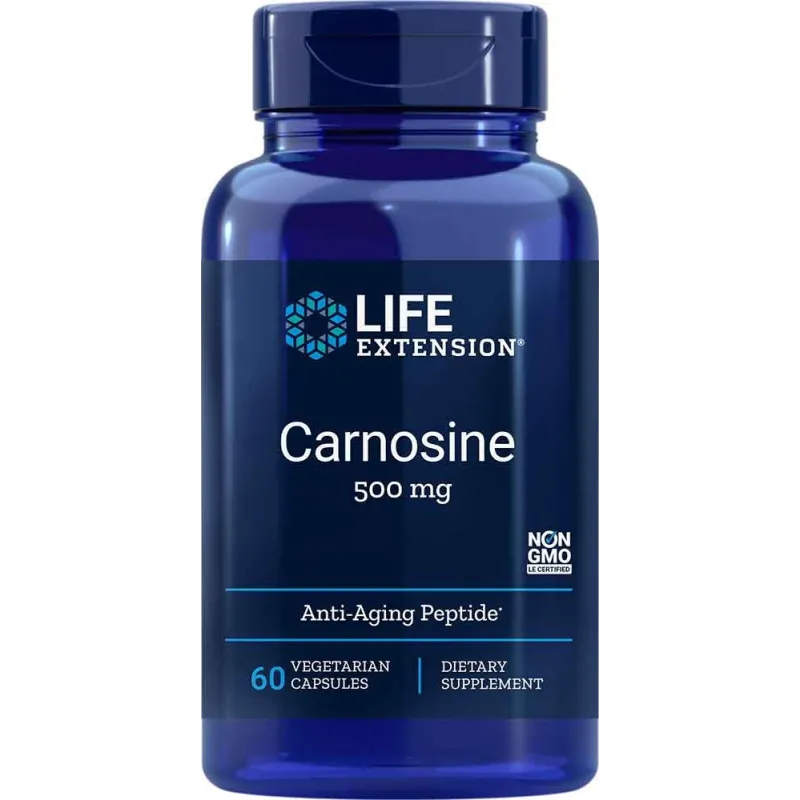
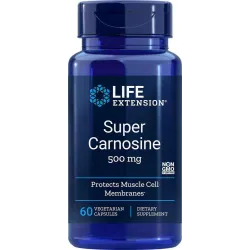
Carnosine
500 mg, 60 vegetarian capsules
Item Catalog Number: 01829

Carnosine is a multifunctional dipeptide made up of the amino acids beta-alanine and L-histidine. It is also a naturally occurring antioxidant and potent glycation-inhibiting nutrient. Carnosine is found both in food as well as the human body. Long-lived cells such as nerve cells (neurons) and muscle cells (myocytes) contain high levels of carnosine. But carnosine levels decline with age, making supplementation an essential part of your whole-body health program.
Benefits at a Glance
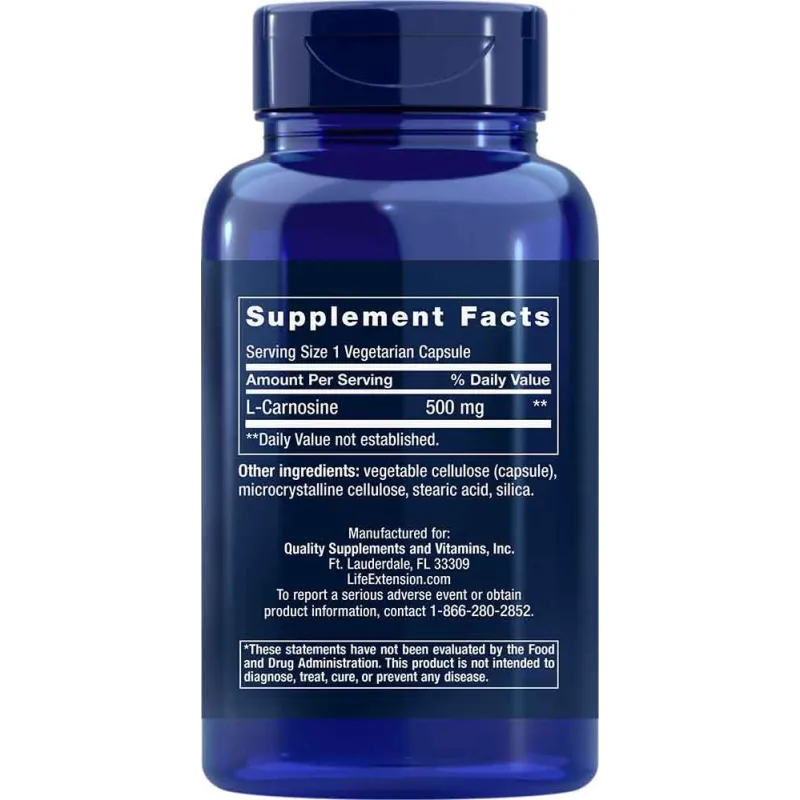
Serving Size 1 vegetarian capsule
| Amount Per Serving | |
|---|---|
| L-Carnosine | 500 mg |
| Other ingredients: vegetable cellulose (capsule), microcrystalline cellulose, stearic acid, silica. | |
Non-GMO
Dosage and Use
Take one (1) capsule once or twice daily with or without food, or as recommended by a healthcare practitioner.
Warnings
KEEP OUT OF REACH OF CHILDREN
DO NOT EXCEED RECOMMENDED DOSE
Do not purchase if outer seal is broken or damaged.
When using nutritional supplements, please consult with your physician if you are undergoing treatment for a medical condition or if you are pregnant or lactating.
23,76 €
34,25 €
32,66 €
38,57 €






Carnosine, a dipeptide composed of beta-alanine and histidine, concentrates in muscle and brain tissues where it provides multifaceted protection against aging processes. Discovered in 1900, carnosine's anti-aging properties weren't fully appreciated until recent decades when research revealed its remarkable abilities. The molecule functions as a potent antioxidant, chelating pro-oxidant metals like copper and zinc that catalyze free radical formation. Beyond simple antioxidant activity, carnosine demonstrates unique anti-glycation properties—it inhibits formation of advanced glycation end products (AGEs) that accelerate aging by cross-linking proteins making them dysfunctional. AGE accumulation drives wrinkles, arterial stiffening, cataract formation, and neurodegeneration. Carnosine levels decline 63% from age 10 to 70, correlating with aging decline. Supplementation raises muscle carnosine by 40-80% depending on dose and duration. Research shows carnosine extends cellular lifespan in culture by 20-30%, protects telomeres from oxidative shortening, and rejuvenates senescent cells.
Carnosine's neuroprotective properties make it particularly valuable for brain health and cognitive preservation. The compound crosses the blood-brain barrier, concentrating in neurons where it protects against multiple age-related insults. Carnosine chelates toxic metals including copper, zinc, and aluminum implicated in Alzheimer's disease, preventing their catalysis of oxidative damage and protein misfolding. The molecule demonstrates specific anti-amyloid properties, inhibiting beta-amyloid aggregation and even dissolving existing plaques in vitro. For Parkinson's disease, carnosine protects dopaminergic neurons from oxidative stress and alpha-synuclein aggregation. Clinical research shows carnosine supplementation at 500-1500 mg daily improves cognitive function scores by 15-25% in elderly individuals with mild cognitive impairment. The compound also supports neurotransmitter function, enhances mitochondrial energy production in neurons, and reduces neuroinflammation through multiple pathways.
Carnosine's high concentration in muscle tissue (20-30 mmol/kg in fast-twitch fibers) reflects its crucial role in exercise metabolism and performance. The primary mechanism involves intramuscular pH buffering—during intense exercise, hydrogen ion accumulation from lactate production decreases muscle pH causing fatigue and performance decline. Carnosine buffers these hydrogen ions, delaying fatigue onset and extending high-intensity exercise capacity. Beta-alanine supplementation (the rate-limiting carnosine precursor) increases muscle carnosine by 40-80% over 4-10 weeks, producing 2-5% improvements in high-intensity exercise lasting 1-10 minutes. This translates to significant athletic gains: additional repetitions in resistance training, faster sprint times, and delayed time to exhaustion. Beyond buffering, carnosine provides antioxidant protection reducing exercise-induced oxidative stress by 30-40%, supports calcium sensitivity in muscle fibers improving contractile function, and enhances muscle recovery between training sessions.
Carnosine demonstrates remarkable protective effects for eye health, particularly against cataract formation and age-related vision decline. The lens concentrates carnosine where it protects crystallin proteins from glycation and oxidative damage that cause opacity and cataract development. Research shows carnosine prevents and even reverses protein glycation in lens tissue, with animal studies demonstrating 50-75% reduction in cataract formation with carnosine supplementation or eye drops. For age-related macular degeneration, carnosine's antioxidant properties protect retinal cells from oxidative stress and AGE accumulation. N-acetylcarnosine eye drops show particular promise, with clinical trials demonstrating 40-90% improvements in visual acuity and lens clarity in cataract patients after 3-6 months. While oral supplementation provides systemic benefits, topical eye drops may offer superior direct delivery to ocular tissues.
Carnosine supplementation faces challenges due to carnosinase enzymes in blood and tissues rapidly breaking down oral carnosine into constituent amino acids. This limits direct carnosine bioavailability to tissues. Two strategies address this: taking high-dose carnosine (1000-2000 mg daily) to saturate carnosinase and allow tissue uptake, or supplementing with beta-alanine (the rate-limiting carnosine precursor) which bypasses carnosinase breakdown. For anti-aging and cognitive benefits, 500-1500 mg carnosine daily shows benefits in trials. For athletic performance, beta-alanine 3-6 grams daily proves more effective, loading muscle carnosine over 4-10 weeks. Zinc-carnosine complexes offer enhanced stability resistant to carnosinase degradation. Sustained-release carnosine formulations may improve tissue delivery. Taking carnosine with meals may slow degradation. For eye health, N-acetylcarnosine drops provide direct ocular delivery. Effects develop progressively—cognitive and anti-aging benefits require 3-6 months, athletic performance improvements emerge over 4-10 weeks of loading.
Results: Clinical trials demonstrate carnosine supplementation at 500-1500 mg daily improves cognitive function scores by 15-25% in elderly individuals with mild cognitive impairment, with neuroprotective effects through anti-glycation and metal chelation mechanisms.
Citation: Boldyrev AA, et al. Biochemistry (Mosc). 2013 Jul;78(7):750-60.
Results: Research shows beta-alanine supplementation increases muscle carnosine by 40-80% over 4-10 weeks, producing 2-5% improvements in high-intensity exercise performance lasting 1-10 minutes through enhanced pH buffering capacity.
Citation: Hobson RM, et al. Amino Acids. 2012 Jul;43(1):25-37.
Results: Studies reveal carnosine inhibits AGE formation, extends cellular lifespan by 20-30% in culture, protects telomeres from oxidative shortening, and demonstrates anti-amyloid properties preventing beta-amyloid aggregation implicated in Alzheimer's disease.
Citation: Hipkiss AR. Exp Gerontol. 2009 Oct;44(10):638-41.
Results: Eye health trials show N-acetylcarnosine drops improve visual acuity by 40-90% and lens clarity in cataract patients after 3-6 months, with animal studies demonstrating 50-75% reduction in cataract formation through anti-glycation protection.
Citation: Babizhayev MA, et al. Drugs R D. 2002;3(2):87-103.