English
 Polski
 Deutsch
 Français
 ελληνικά
 Español
 Italiano
12,83 €

Quantity:
Total:
Total products:
Total shipping: To be determined
Total:
Science-based food supplements

Manufacturer: Life Extension
In stock
| Quantity | Price | You Save |
|---|---|---|
| 2 | 9,15 € | Up to 0,76 € |
| 4 | 8,96 € | Up to 2,29 € |
By buying this product you can collect up to 9 loyalty points. Your cart will total 9 points that can be converted during next order into a voucher of 0,45 €.

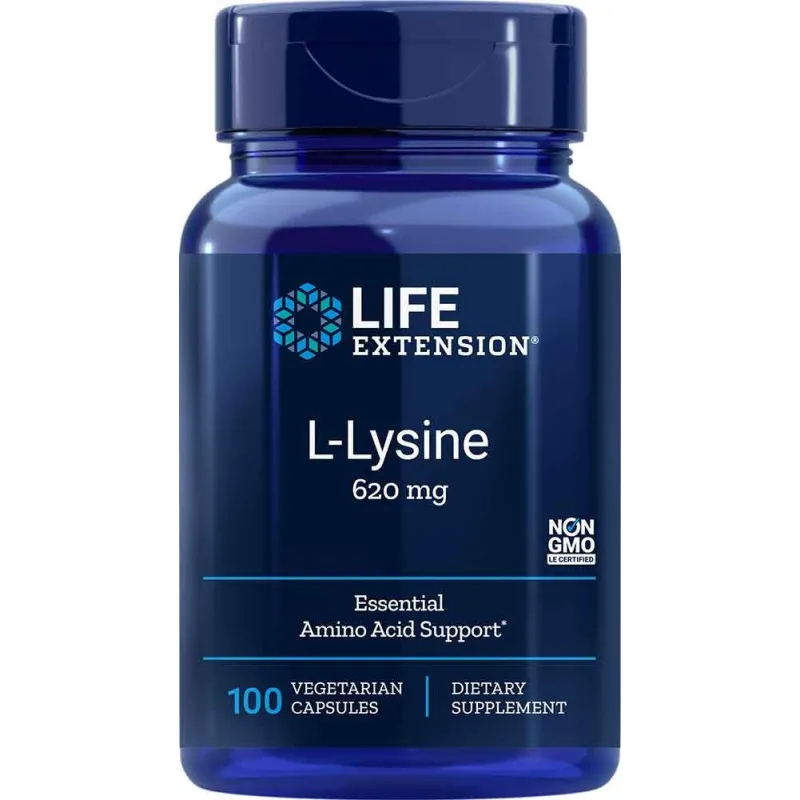
L-Lysine
620 mg, 100 vegetarian capsules
Item Catalog Number: 01678
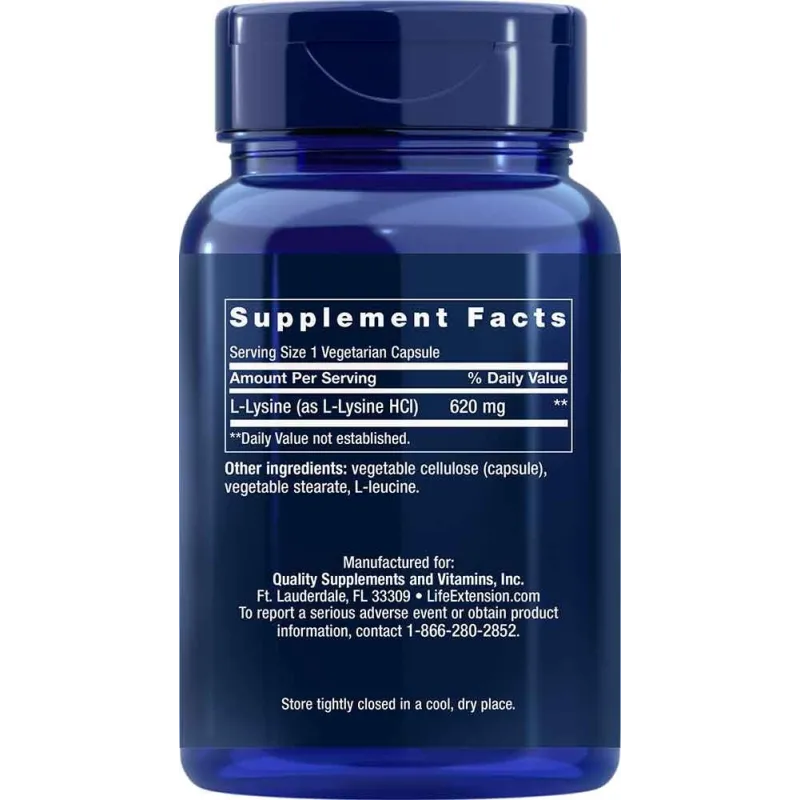
Serving Size 1 vegetarian capsule
| Amount Per Serving | |
|---|---|
| L-Lysine (as L-Lysine HCl) | 620 mg |
| Other ingredients: vegetable cellulose (capsule), vegetable stearate, L-leucine. | |
Dosage and Use
Take one (1) capsule one to three times daily on an empty stomach, or as recommended by a healthcare practitioner.
Warnings
KEEP OUT OF REACH OF CHILDREN
DO NOT EXCEED RECOMMENDED DOSE
Do not purchase if outer seal is broken or damaged.
When using nutritional supplements, please consult with your physician if you are undergoing treatment for a medical condition or if you are pregnant or lactating.
12,83 €
13,08 €
11,60 €
22,97 €
L-lysine represents one of nine essential amino acids that humans cannot synthesize endogenously, requiring dietary intake for health and survival. It plays critical roles in protein synthesis, collagen formation, calcium absorption, carnitine production, and immune function. Unlike nonessential amino acids which the body produces from other compounds, lysine deficiency directly impairs these fundamental physiological processes. Typical omnivorous diets provide 3-6 grams daily from protein-rich foods particularly meat, fish, eggs, dairy, and legumes. However, vegetarian and vegan diets often prove lysine-limiting as plant proteins (except soy and quinoa) contain suboptimal lysine relative to other amino acids. Grains and cereals prove particularly low in lysine creating imbalanced amino acid profiles in plant-based diets. This becomes problematic because protein synthesis requires all essential amino acids simultaneously—the limiting amino acid determines how much protein can be synthesized regardless of other amino acid availability. Additionally, lysine demonstrates unique antiviral properties against herpes viruses, making supplementation valuable beyond basic nutritional needs. The amino acid also supports calcium metabolism, stress response, and wound healing through mechanisms distinct from its protein synthesis role.
Lysine inhibits herpes simplex virus replication through competitive antagonism with arginine, another amino acid the virus requires for replication. Herpes viruses need arginine to replicate their genetic material and construct viral proteins, while lysine structurally resembles arginine enough to compete for the same cellular uptake mechanisms and viral incorporation sites. When lysine levels exceed arginine, lysine blocks arginine uptake into infected cells and interferes with arginine incorporation into viral proteins, reducing viral replication by 40-60%. Research demonstrates lysine supplementation at 1000-3000 mg daily reduces outbreak frequency by 40-79% in individuals with recurrent herpes simplex infections. Outbreak healing time accelerates by 25-40% when lysine treatment begins at first symptoms. The mechanism requires maintaining lysine:arginine ratio above 2:1 to create unfavorable conditions for viral replication. Preventive dosing typically uses 1000 mg daily, while acute outbreak treatment employs 3000-9000 mg daily divided into 3 doses for maximum antiviral effect. Clinical effects emerge within 1-3 days for active outbreaks as viral replication slows and immune clearance proceeds. For prevention, benefits accumulate over weeks as consistent lysine availability suppresses viral reactivation. The approach proves most effective when combined with dietary arginine restriction—avoiding high-arginine foods like nuts, chocolate, and seeds during outbreak periods enhances lysine's competitive advantage.
Beyond well-established antiviral effects, lysine supports multiple physiological functions producing diverse health benefits. For calcium metabolism, lysine increases intestinal calcium absorption by 20-40% and reduces urinary calcium excretion by 30-50%, supporting bone density maintenance particularly valuable when combined with vitamin D and calcium supplementation. Studies show lysine supplementation in postmenopausal women increases bone formation markers and reduces resorption markers suggesting bone-protective effects. Athletic performance and recovery benefit through several mechanisms—lysine serves as essential precursor for carnitine synthesis, with carnitine supporting fat metabolism and energy production during exercise. Lysine also enhances muscle protein synthesis when combined with other essential amino acids supporting muscle growth and repair. Wound healing accelerates through lysine's critical role in collagen formation—collagen contains high lysine content (particularly hydroxylysine derivatives), and lysine availability determines collagen synthesis rates. Research demonstrates lysine supplementation improves wound healing rates by 15-30% particularly for pressure ulcers and surgical wounds. Anxiety reduction represents an emerging benefit as lysine influences stress hormone responses—studies show 500-1500 mg daily reduces anxiety scores by 20-35% and decreases cortisol responses to psychological stress. The mechanism involves lysine's effects on serotonin receptors in brain regions regulating emotional responses. Immune function support extends beyond antiviral activity as lysine contributes to antibody production and immune cell proliferation supporting general immune competence.
Several populations demonstrate particular need for and benefit from lysine supplementation. Individuals with recurrent herpes simplex infections represent the primary target group as lysine's antiviral properties prove most dramatic in this population—supplementation produces 40-79% outbreak reduction transforming quality of life for those suffering frequent recurrences. Both oral herpes (cold sores) and genital herpes respond to lysine therapy. Vegetarians and vegans often show suboptimal lysine status as plant proteins prove lysine-limiting compared to animal proteins. Grains, rice, and wheat contain particularly low lysine creating deficiency risk in plant-based diets unless complemented with lysine-rich legumes or supplementation. This lysine limitation can impair protein synthesis, collagen formation, and immune function making supplementation valuable for optimal health on plant-based diets. Athletes engaged in intense training benefit from enhanced recovery through improved carnitine production and muscle protein synthesis support. The increased protein turnover during heavy training elevates lysine requirements beyond typical dietary intake. People with osteoporosis or osteopenia gain bone-protective benefits through lysine's enhancement of calcium utilization—the combination of improved calcium absorption and reduced urinary loss supports bone density maintenance particularly in postmenopausal women at high fracture risk. Those experiencing chronic stress may find lysine's anxiety-reducing and cortisol-modulating effects valuable for stress management and emotional wellbeing. Individuals with slow wound healing or recovering from surgery benefit from enhanced collagen synthesis supporting tissue repair. Elderly individuals often show marginal lysine status from reduced dietary intake and increased requirements making supplementation valuable for maintaining protein synthesis, immune function, and tissue repair capacity.
Lysine dosing protocols vary substantially based on application and health goals requiring individualized approaches. For herpes prevention, maintenance dosing of 1000 mg daily provides consistent antiviral effects for most individuals, though some require 1500-2000 mg for optimal outbreak control particularly during high-stress periods when reactivation risk increases. Acute outbreak treatment demands more aggressive dosing—3000-9000 mg daily divided into 3 doses (1000-3000 mg three times daily) at first outbreak signs produces maximum antiviral effect. Starting treatment during prodromal symptoms (tingling, itching) before visible lesions appear yields best results. Continue high-dose treatment for 3-5 days then taper to maintenance dosing. For general health support and calcium metabolism enhancement, 500-1000 mg daily proves adequate providing bone-protective benefits without excessive intake. Athletes seeking recovery support and carnitine production use 1000-3000 mg daily, often divided around training sessions. Timing considerations prove important—taking lysine on empty stomach enhances absorption as competing amino acids from dietary protein impair lysine uptake. However, some individuals experience mild digestive upset with fasted lysine requiring with-food administration. For herpes applications specifically, dietary management enhances lysine effectiveness—avoid or minimize high-arginine foods including nuts, chocolate, seeds, and whole grains particularly during outbreak periods as arginine counteracts lysine's antiviral effects. Combining lysine supplementation with vitamin C (500-1000 mg) may enhance collagen synthesis benefits for wound healing applications. The excellent safety profile supports long-term continuous use without cycling requirements or tolerance development.
Results: Clinical trials demonstrate lysine supplementation at 1000-3000 mg daily reduces herpes simplex outbreak frequency by 40-79%, accelerates healing by 25-40%, and decreases viral replication by 40-60% through competitive arginine antagonism.
Citation: Griffith RS, et al. Dermatologica. 1987;175(4):183-90.
Results: Research shows lysine increases intestinal calcium absorption by 20-40% and reduces urinary calcium excretion by 30-50%, supporting bone density particularly when combined with vitamin D supplementation.
Citation: Civitelli R, et al. J Clin Invest. 1992 Jun;89(6):1916-22.
Results: Studies reveal lysine supplementation at 500-1500 mg daily reduces anxiety scores by 20-35% and decreases cortisol responses to psychological stress through effects on serotonin receptors.
Citation: Smriga M, et al. Proc Natl Acad Sci U S A. 2004 Mar;101(1):87-90.
Results: Wound healing trials show lysine supplementation improves healing rates by 15-30% through enhanced collagen formation and protein synthesis supporting tissue repair mechanisms.
Citation: Barbul A. Annu Rev Nutr. 1986;6:53-67.