English
 Polski
 Deutsch
 Français
 ελληνικά
 Español
 Italiano
13,03 €

Quantity:
Total:
Total products:
Total shipping: To be determined
Total:
Science-based food supplements

Manufacturer: Life Extension
Waiting for delivery
| Quantity | Price | You Save |
|---|---|---|
| 2 | 8,27 € | Up to 0,69 € |
| 4 | 8,09 € | Up to 2,07 € |
By buying this product you can collect up to 8 loyalty points. Your cart will total 8 points that can be converted during next order into a voucher of 0,40 €.

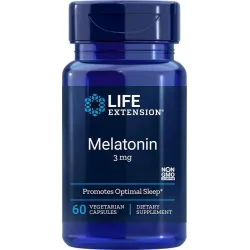
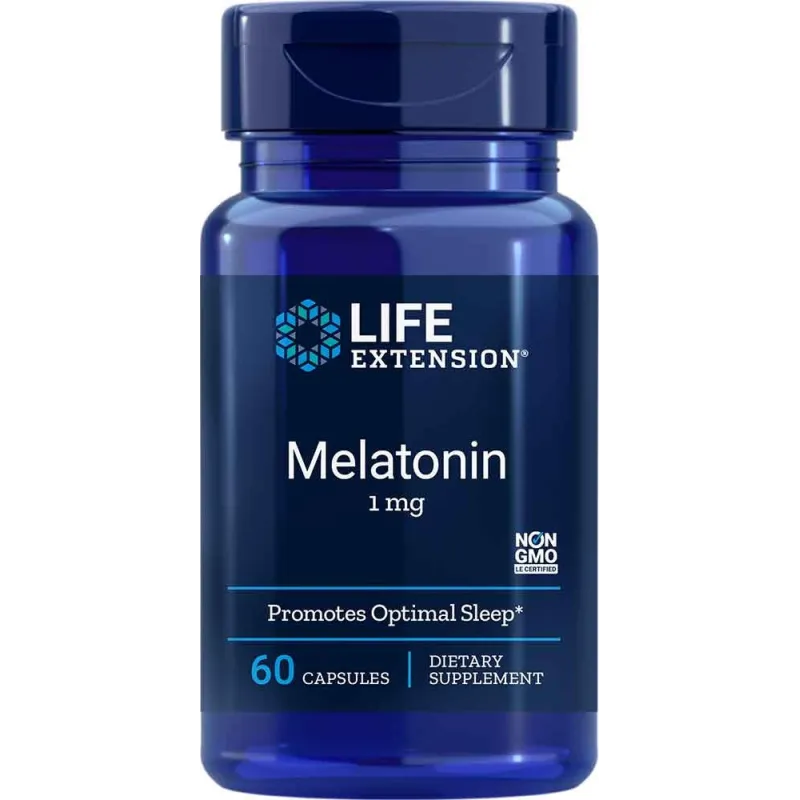
Melatonin
1 mg, 60 capsules
Item Catalog Number: 00329EU

Melatonin increases the speed of falling asleep and adds to the quality of sleep. It also has a strong antioxidant property and is important for protecting cellular DNA.
Benefits at a Glance
Melatonin is a hormone derived from the amino acid tryptophan. Melatonin is primarily synthesized by our pineal gland and released mostly at night to make falling asleep easier. In addition to healthy sleep support, melatonin has strong antioxidant properties and has been shown to support immune health, and healthy brain function, and more.
A good night's sleep is crucial for overall health and well-being. But many people experience difficulty falling asleep and staying asleep. Healthy sleep patterns are governed by your body's circadian rhythm, and melatonin helps keep your circadian rhythm in tune.1,2 But melatonin release declines with age,3-5 and can be affected by jet lag, shift work, and even vision health.6-8
Melatonin also has strong antioxidant properties. It directly scavenges both hydroxyl and peroxyl free radicals, and it does so more effectively than most other antioxidants. It also greatly potentiates the efficiency of other endogenous and exogenous antioxidants.9
Melatonin is especially important for healthy cellular DNA support because it helps inhibit peroxynitrite free radical reactions.10 Melatonin has been found to be better than glutathione-3, vitamin C, and even vitamin E at helping to inhibit oxidative damage.11
Melatonin has a beneficial impact on the immune system—it activates T-helper cells, which trigger other immune cells to boost immune system response to foreign molecules.12,13
Age-related cognitive decline may be directly correlated to melatonin levels.14-16 Melatonin supplementation can help support the brain's normal antioxidant protection, and help inhibit factors that can lead to cognitive decline.17-20
Support optimal sleep and well-being. Add melatonin to your health regimen today!
For occasional sleeplessness.
Caution:
Consult your healthcare provider before taking this product if you are being treated for a medical condition (especially autoimmune or depressive disorders). Use caution if combining with alcohol. This product is not intended for children, pregnant or lactating women, or women trying to become pregnant. Do not attempt to drive or operate heavy machinery after taking this product.
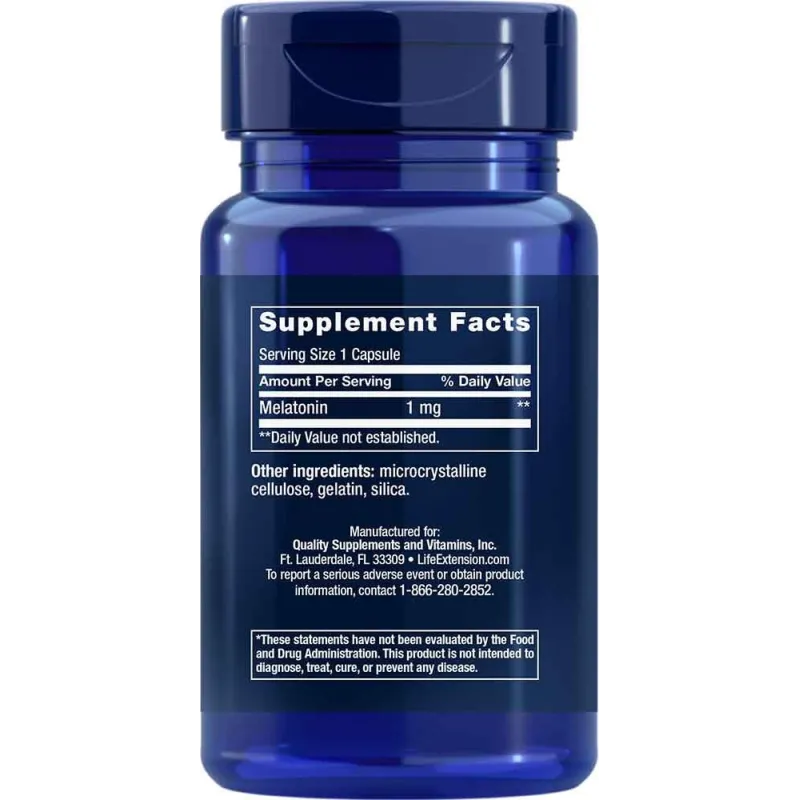
Serving Size 1 capsule
| Amount Per Day (1capsule) | |
|---|---|
|
Melatonin |
1 mg |
|
Ingredients: Bulking agent (microcrystalline cellulose/cellulose gel), capsule (gelatine), anti-caking agent (silicon dioxide [nano]), melatonin. |
|
Non-GMO
Dosage and Use
Take one (1) capsule 30 to 60 minutes before bedtime, or as recommended by a healthcare practitioner. Melatonin is naturally secreted from the pineal gland at night, and should be taken at night for optimal results.Take one (1) capsule 30 to 60 minutes before bedtime, or as recommended by a healthcare practitioner. Melatonin is naturally secreted from the pineal gland at night, and should be taken at night for optimal results.
Do not consume alcohol, drive or operate machinery after taking this product.
Keep out of reach of children.
Do not exceed recommended daily dose.
Do not purchase if outer seal is broken or damaged.
Consult with your physician if you are undergoing treatment for a medical condition or if you are pregnant or lactating.
A food supplement should not be used as a substitute for a varied and balanced diet and a healthy lifestyle. Store tightly closed in a cool, dry place.
13,03 €

47,31 €
11,60 €
19,65 €
Melatonin is a hormone naturally produced by the pineal gland that regulates the body's circadian rhythm and sleep-wake cycle. Production increases in darkness and decreases with light exposure, signaling the body that it's time for sleep. Melatonin doesn't force sleep like sedatives but rather signals the body's natural sleep processes to begin. It helps reduce the time needed to fall asleep, supports sleep quality, and helps maintain regular sleep patterns. Modern lifestyle factors including artificial light exposure, shift work, and electronic device use can disrupt natural melatonin production, making supplementation beneficial for restoring healthy sleep patterns and circadian rhythm regulation.
The 1 mg dose closely mimics the body's natural melatonin production levels, making it physiologically appropriate for sleep support. While higher doses (3-10 mg) are common, research suggests lower doses are often equally effective with fewer side effects. Studies show 1 mg effectively reduces sleep latency and improves sleep quality without causing morning grogginess that higher doses may produce. Lower doses also maintain the body's natural sensitivity to melatonin, preventing tolerance development. The 1 mg dose is particularly suitable for people new to melatonin, older adults who may be more sensitive, and those seeking gentle sleep support without sedative effects. It allows for dose adjustment upward if needed.
Melatonin is particularly effective for certain sleep issues. It helps with delayed sleep phase syndrome where people naturally fall asleep and wake much later than desired. Jet lag recovery is significantly improved as melatonin helps reset circadian rhythm to new time zones. Shift workers experiencing disrupted sleep patterns benefit from melatonin's ability to adjust sleep timing. Older adults with reduced natural melatonin production often find supplementation restores sleep quality. Occasional insomnia characterized by difficulty falling asleep responds well to melatonin. It's also helpful for people with irregular sleep schedules. Melatonin works best for sleep timing issues rather than sleep maintenance problems where other approaches may be more appropriate.
For optimal results, take melatonin 30-60 minutes before your desired bedtime. This timing allows melatonin levels to rise as you prepare for sleep, mimicking natural production patterns. Take it at the same time each night to help establish consistent sleep rhythm. For jet lag, take melatonin at the bedtime of your destination time zone. Create a sleep-conducive environment by dimming lights after taking melatonin as bright light can interfere with its effects. Avoid screens and blue light exposure which suppress melatonin effectiveness. Start with 1 mg and only increase if needed after several nights. Use lowest effective dose for sleep support to maintain natural melatonin sensitivity and avoid tolerance.
Melatonin has excellent safety profile when used appropriately for sleep support. Most people experience no side effects at the 1 mg dose. Occasionally, some individuals report mild morning grogginess, vivid dreams, or slight headache, which usually resolve with continued use or dose reduction. Unlike sedative medications, melatonin is not habit-forming and doesn't impair next-day function when used at appropriate doses. However, pregnant or nursing women should avoid melatonin. People with autoimmune conditions, depression, or seizure disorders should consult physicians before use. Those taking medications including blood thinners, immunosuppressants, or diabetes medications should verify compatibility. Short-term and long-term studies support melatonin's safety for most adults.
Results: Clinical studies demonstrate melatonin supplementation significantly reduces sleep latency (time to fall asleep) by an average of 7-12 minutes and improves overall sleep quality in individuals with insomnia or delayed sleep phase disorder.
Citation: Ferracioli-Oda E, et al. PLoS One. 2013 May;8(5):e63773.
Results: Research shows melatonin effectively reduces jet lag symptoms, with studies demonstrating faster adaptation to new time zones and improved sleep quality when melatonin is taken at appropriate times relative to destination bedtime.
Citation: Herxheimer A, Petrie KJ. Cochrane Database Syst Rev. 2002;(2):CD001520.
Results: Studies indicate lower melatonin doses (0.3-1 mg) produce blood levels similar to natural nocturnal melatonin peaks and are often as effective as higher doses for sleep onset, with reduced risk of next-day residual effects.
Citation: Zhdanova IV, et al. Clin Pharmacol Ther. 1996 Dec;60(5):552-9.
Results: Clinical trials confirm melatonin has excellent safety profile with minimal adverse effects at physiological doses, with long-term studies showing no development of tolerance or withdrawal symptoms upon discontinuation.
Citation: Buscemi N, et al. J Gen Intern Med. 2005 Dec;20(12):1151-8.