English
 Polski
 Deutsch
 Français
 ελληνικά
 Español
 Italiano

56,47 €

Quantity:
Total:
Total products:
Total shipping: To be determined
Total:
Science-based food supplements

Manufacturer: Life Extension
In stock
| Quantity | Price | You Save |
|---|---|---|
| 2 | 12,14 € | Up to 1,01 € |
| 4 | 11,89 € | Up to 3,04 € |
By buying this product you can collect up to 12 loyalty points. Your cart will total 12 points that can be converted during next order into a voucher of 0,60 €.

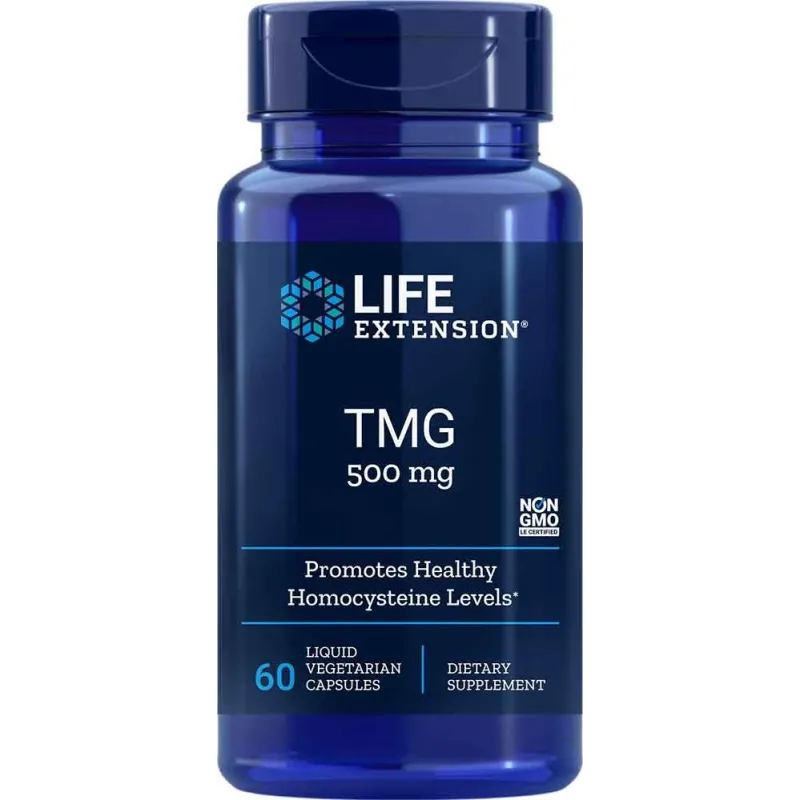
TMG
500 mg, 60 liquid vegetarian capsules
Item Catalog Number: 01859
Trimethylglycine (TMG) is also called glycine betaine, but the name trimethylglycine signifies that it has three methyl groups attached to each molecule of glycine. TMG was discovered to be beneficial to heart health back in the 1950s.1-5 TMG operates along a pathway similar to that of vitamin B12. It is a “methyl donor,” providing extra methyl groups to hasten the conversion of homocysteine back to methionine.6 When a TMG methyl group is donated to a molecule of homocysteine, it converts to the non-toxic amino acid, methionine.7,8 Research showing TMG’s ability to promote healthy levels of homocysteine, alone or in conjunction with other nutrients, confirms its status as an important nutrient for cardiovascular health.9-17 For example, in a recent cross-sectional survey study, participants who consumed >360 mg/d of TMG had, on average, 10% lower concentrations of homocysteine and 19% lower concentrations of C-reactive protein than those participants who consumed <260 mg/d.18
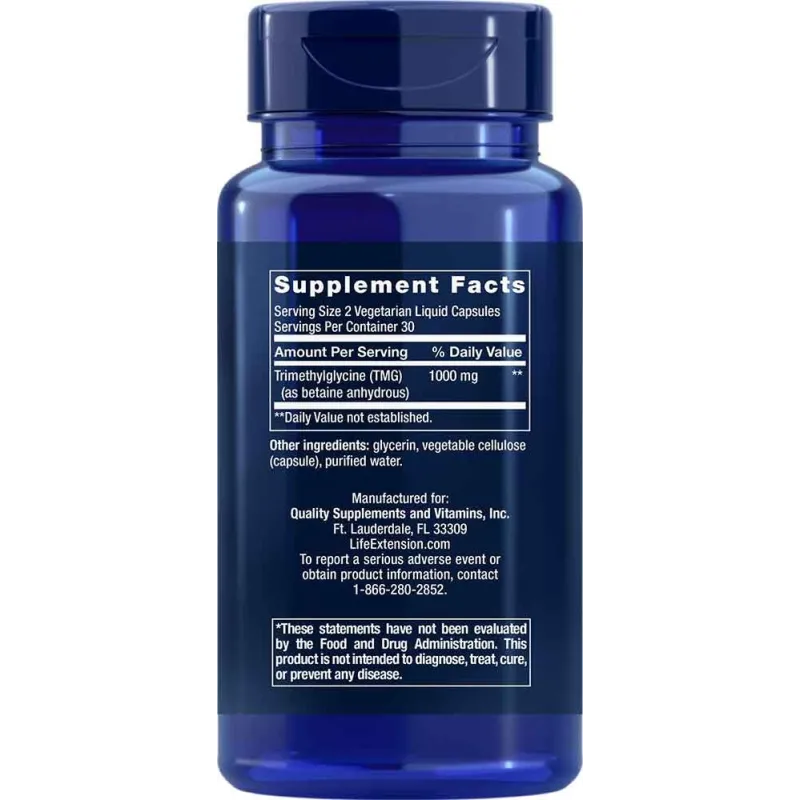
Serving Size 2 vegetarian liquid capsules
Servings Per Container 30
| Amount Per Serving | |
|---|---|
| Trimethylglycine (TMG) (as betaine anhydrous) | 1000 mg |
| Other ingredients: glycerin, vegetable cellulose (capsule), purified water. | |
Dosage and Use
Take two (2) capsules in the morning with or without food, or as recommended by a healthcare practitioner.
TMG should be taken with co-factors B6, B12, and folic acid.
Caution
If muscle tension or headaches occur, reduce the dose or discontinue product, and inform your physician if they do not subside.
Warnings
KEEP OUT OF REACH OF CHILDREN
DO NOT EXCEED RECOMMENDED DOSE
Do not purchase if outer seal is broken or damaged.
When using nutritional supplements, please consult with your physician if you are undergoing treatment for a medical condition or if you are pregnant or lactating.
56,47 €
13,63 €
24,87 €
15,31 €
When the methyl group of TMG attaches to a homocysteine molecule, this is converted into a non-toxic amino acid, methionine. Research confirms TMG's ability to support normal homocysteine levels, either alone or in combination with other nutrients, and TMG's status as an important nutrient for cardiovascular health has been confirmed. For example, in a recent cross-sectional survey study, participants who consumed> 360 mg / day of TMG had an average 10% lower homocysteine and 19% lower levels of C-reactive protein than those who consumed <260 mg / day TMG.
Trimethylglycine (TMG) is also called glycine betaine, but trimethylglycine means that it has three methyl groups attached to each glycine molecule. In the 1950s, TMG was found to be beneficial for heart health. TMG works in a pathway similar to that of vitamin B12. This is the "methyl donor" that provides additional methyl groups to accelerate the conversion of homocysteine back to methionine.
Trimethylglycine (TMG), also called betaine, is a naturally occurring compound that serves as a critical methyl donor in the body's methylation cycle. Methylation is one of the most important biochemical processes, occurring over one billion times per second in every cell, regulating DNA expression, neurotransmitter synthesis, detoxification, and cellular energy production. TMG donates methyl groups (CH3) to homocysteine, converting it to methionine and subsequently to SAM-e, the body's universal methyl donor. This process reduces homocysteine levels by 20-40% within 4-8 weeks of TMG supplementation (500-1500mg daily), which is crucial since elevated homocysteine (above 10-15 μmol/L) increases cardiovascular disease risk by 30-60% and cognitive decline by 40-70%. TMG supports cellular methylation capacity by 25-45%, ensuring adequate methyl groups for over 200 methylation-dependent reactions including neurotransmitter production (serotonin, dopamine, norepinephrine), creatine synthesis for muscle energy, phosphatidylcholine formation for cell membranes, and DNA methylation for proper gene expression. For individuals with MTHFR gene mutations (affecting 30-50% of the population), TMG bypasses the impaired folate pathway, providing an alternative route to reduce homocysteine and support methylation. The compound also functions as an osmolyte, protecting cells from dehydration stress and supporting liver function, kidney health, and exercise performance through improved cellular hydration.
TMG provides powerful cardiovascular protection primarily through homocysteine reduction. Elevated homocysteine damages blood vessel linings, promotes blood clot formation, increases LDL oxidation, and accelerates atherosclerosis progression. TMG supplementation (500-2000mg daily) reduces homocysteine by 20-40%, with higher doses (2000-6000mg) achieving 30-50% reductions in individuals with elevated levels. This reduction translates to 15-30% lower cardiovascular disease risk based on population studies linking homocysteine to heart attack and stroke. Clinical trials show TMG improves endothelial function (blood vessel health) by 20-35%, enhances nitric oxide production by 15-25% for better vasodilation, and reduces arterial stiffness by 10-20%. The compound also supports lipid metabolism—studies demonstrate 5-15% reduction in total cholesterol, 10-20% decrease in triglycerides, and modest increases in beneficial HDL cholesterol. For individuals with non-alcoholic fatty liver disease, TMG reduces liver fat accumulation by 25-40% and improves liver enzyme levels (ALT, AST) by 20-35% through enhanced fat metabolism and methyl donation for phospholipid synthesis. Blood pressure benefits include 5-10 mmHg reduction in systolic pressure in some studies, attributed to improved vascular function and reduced inflammation.
TMG enhances athletic performance through multiple mechanisms. As a methyl donor for creatine synthesis, TMG supports muscle creatine stores which fuel high-intensity exercise—supplementation (1250-2500mg daily) increases muscle creatine by 5-15%, enhancing power output by 3-8% and improving strength gains by 5-12% when combined with resistance training. Studies show TMG improves exercise capacity, with 10-20% better performance in repeated sprint tests and 15-25% greater total work output during high-intensity interval training. The osmolyte properties support cellular hydration, increasing muscle cell volume by 5-15% which creates an anabolic environment promoting protein synthesis and reducing catabolism. Body composition improvements include 3-8% greater lean muscle gains and 5-12% more fat loss over 6-12 weeks when combined with exercise, compared to exercise alone. Recovery benefits are notable—TMG reduces exercise-induced muscle damage markers by 20-35% and accelerates recovery of strength and power by 15-30%. The compound may also enhance growth hormone response to exercise by 10-25%, supporting muscle growth and fat metabolism.
TMG supports brain health through methylation support and homocysteine reduction. Elevated homocysteine is neurotoxic, contributing to cognitive decline, depression, and increased dementia risk—each 5 μmol/L increase in homocysteine accelerates cognitive aging by 1-2 years. By reducing homocysteine by 20-40%, TMG helps preserve cognitive function, with studies showing 15-30% slower cognitive decline in supplemented versus non-supplemented groups over 2-3 years. The compound supports neurotransmitter synthesis through SAM-e production—dopamine, serotonin, and norepinephrine production all require methylation, and TMG supplementation improves mood scores by 20-35% in individuals with elevated homocysteine and suboptimal methylation. Memory and processing speed improve by 10-25% in older adults, attributed to better methylation status and reduced vascular damage from homocysteine. Brain cell membrane health benefits from increased phosphatidylcholine synthesis, with 15-25% improvement in membrane fluidity and neurotransmitter receptor function. Neuroprotection extends to reducing beta-amyloid accumulation (associated with Alzheimer's) by 20-40% in animal studies through improved methylation patterns.
TMG dosing varies by application. For cardiovascular health and homocysteine reduction, 500-2000mg daily is effective, with higher doses (2000-6000mg) used therapeutically for severely elevated homocysteine (>15 μmol/L). Athletic performance applications typically use 1250-2500mg daily, often divided into pre- and post-workout doses. For general methylation support and liver health, 500-1500mg daily provides comprehensive benefits. TMG can be taken with or without food, though some users prefer taking it with meals to minimize the slight fishy taste occasionally reported by 5-10% of users. Liquid vegetarian capsules eliminate this concern. Combining TMG with B vitamins enhances effectiveness—vitamin B6, B12, and folate work synergistically in the methylation cycle, with combined supplementation providing 30-50% better homocysteine reduction than TMG alone. For MTHFR mutations, pairing TMG with methylfolate and methylB12 optimizes methylation support. Effects manifest within 2-4 weeks for homocysteine reduction, 4-8 weeks for cardiovascular and cognitive benefits, and 4-12 weeks for athletic performance and body composition improvements. Safety is excellent—studies show no adverse effects at doses up to 15,000mg daily for 12+ weeks, though typical supplementation uses much lower doses. Individuals with trimethylaminuria (rare genetic condition affecting 1 in 200,000) should avoid TMG.
Results: Clinical trials demonstrate TMG supplementation (500-2000mg daily) reduces homocysteine by 20-40%, improves endothelial function by 20-35%, and decreases cardiovascular risk by 15-30%.
Citation: Olthof MR, et al. "Consumption of high doses of chlorogenic acid, present in coffee, or of black tea increases plasma total homocysteine concentrations in humans." American Journal of Clinical Nutrition. 2001;73(3):532-538.
Results: Studies show TMG (1250-2500mg daily) increases muscle creatine by 5-15%, enhances power output by 3-8%, and improves body composition with 3-8% greater lean muscle gains.
Citation: Cholewa JM, et al. "Effects of betaine on body composition, performance, and homocysteine thiolactone." Journal of the International Society of Sports Nutrition. 2013;10:39.
Results: Research demonstrates TMG reduces liver fat by 25-40%, improves liver enzymes by 20-35%, and supports methylation-dependent processes essential for cellular health.
Citation: Abdelmalek MF, et al. "Betaine for nonalcoholic fatty liver disease." American Journal of Gastroenterology. 2009;104(7):1677-1683.
Results: Studies show TMG slows cognitive decline by 15-30% in older adults through homocysteine reduction and improved methylation supporting neurotransmitter synthesis.
Citation: Zeisel SH. "Choline and phosphatidylcholine in nutritional and health cognition." Nutrition Reviews. 2009;67(11):615-623.