English
 Polski
 Deutsch
 Français
 ελληνικά
 Español
 Italiano
24,96 €

Quantity:
Total:
Total products:
Total shipping: To be determined
Total:
Science-based food supplements

Manufacturer: Kenay GmbH
In stock
| Quantity | Price | You Save |
|---|---|---|
| 2 | 29,28 € | Up to 2,44 € |
| 4 | 28,67 € | Up to 7,32 € |
By buying this product you can collect up to 30 loyalty points. Your cart will total 30 points that can be converted during next order into a voucher of 1,50 €.

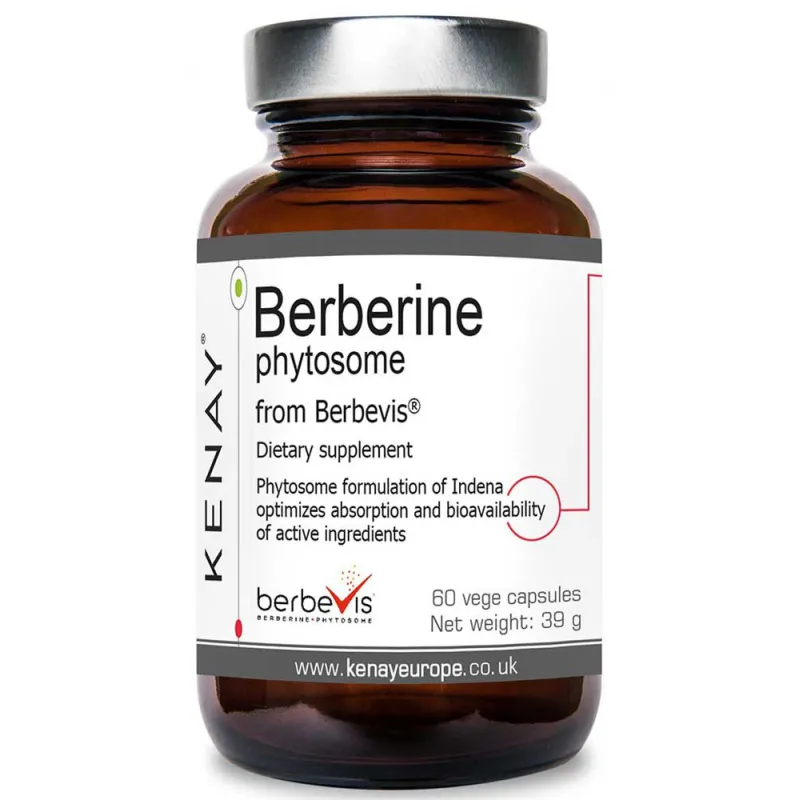
Phytosomal Berberine from Berbevis®
60 capsules
Item Catalog Number: K2516EN
Original product name: Phytosomal Berberine from Berbevis®
Berberine is a natural alkaloid obtained from the Indian barberry (Berberis aristata). Berberine has been used in traditional Chinese and Ayurvedic medicine for centuries.
Our supplement contains the phytosomal form of berberine - Berbevis® developed by Indena.
Berbevis® has been extensively tested in vitro, in vivo and in studies involving humans, where its health-promoting effects have been clearly confirmed. Berberine in the form of Berbevis® supports metabolic health by beneficially modulating the insulin response, normalizes the blood sugar profile (balances both sugar and insulin levels), optimizes the lipid profile, has a beneficial effect on body composition and causes the redistribution of fat tissue.[2]
Phytosome® delivery system used in Berbevis® improves very favourably the original berberine’s bioavailability. Phytosome® delivery system is based on a new custom formulation with 3 innovative features:
- pea proteins used as carrier within the Phytosome® matrix,
- the use of Berberis aristata raw extract, more soluble than pure berberine.
- grape seed extract as a powerful, natural antioxidant to protect the intestinal mucosa against the known gastrointestinal adverse effects of traditional berberine, optimizing its tolerability.[2]
Metformin and Berberine show similar effects. Both are used in the treatment of diabetes and insulin resistance and both affect AMPK (enzyme involved in the regulation of glucose and fat metabolism) activation. AMPK influences body fat composition and plays a critical role in regulating appetite.[1,11] Metformin affects glucose metabolism, thereby reducing blood sugar levels. Berberine has a similar effect, it also affects the metabolism by reducing insulin resistance. In diabetes and an elevated lipid profile, berberine may be an effective alternative to metformin.[11]
Berberine stronger influences fat metabolism and this may help in the fight against obesity because the effect of berberine is more effective than metformin in regulating lipid metabolism.
Benefits at a Glance:
Berberine activates the 5′-adenosine monophosphate-activated protein kinase (AMPK) pathway, increases glucagon-like peptide-1 (GLP-1) levels, reduces reactive oxygen species production, reverses mitochondrial dysfunction, and suppresses inflammation [4,5].
Berberine supplementation in patients with metabolic syndrome can effectively regulate blood glucose and lipids, reduce insulin resistance and inflammatory response levels.[6]
A clinical trial involving rats was conducted to assess whether Berberine could be effective in the treatment of hypertension in diabetes. In an 8-week study, rats received intragastric Berberine at doses of 50, 100 and 200 mg/kg/day.[7,8]
Studies have shown that regular administration of Berberine at a dose of 100 mg/kg/day not only lowered blood glucose levels, but also lowered blood pressure and improved vasodilation in diabetic rats. The study suggests that berberine not only lowers blood pressure but also improves vasodilation in diabetic rats. Berberine works by activating the potassium channel activated by high conductivity calcium ions (BKCa) in vascular smooth muscle cells (VSMC). Berberine may therefore be used in combination therapy to control hyperglycemia and blood pressure in people with diabetes. As shown in the study, activation of the BKCa channel may be the primary mechanism of action of Berberine responsible for the protection of blood vessels in diabetic patients.[7,8]
Berberine's antioxidant, anti-proliferative, and anti-inflammatory actions inhibit aberrant cell behaviors, such as oxidative stress, proliferation, migration, recruitment, adhesion, and inflammation in cardiovascular diseases. Those actions have been widely substantiated in cell experiments, animal models, and human studies.[12]
Berberine protects endothelial cells from cytokines and inflammatory factors to attenuate vessel remodeling. It also inhibits stimulated vascular smooth muscle cells proliferation to prevent vascular stenosis. Vascular endothelial dysfunction is an early sign in atherosclerosis. Berberine inhibits endothelial dysfunction and boosts endothelial regeneration process.[12,13]
Berberine helps reduce elevated cholesterol and triglyceride levels. One study involved 32 adult participants who didn't use any therapy to improve their lipid profile. Study participants received berberine at a dose of 500 mg twice a day for three months. Participants in this study had significant reductions from baseline in LDL, triglycerides, and total cholesterol. The LDL level decreased by 25%, the triglyceride level by 35%, and the total cholesterol level decreased by 29%.(9,10)
Berberine may support bone health and help prevent osteoporosis. Berberine mainly regulates the estrogen and thyroid hormone signaling pathways, which allows for multidirectional support in the treatment of osteoporosis[14]
Supplementation of 100 mg berberine sulfate trihydrate in healthy postmenopausal women may promote bone formation and reduce bone turnover by reducing serum osteocalcin concentrations and increasing serum vitamin D levels.[14]
Berberine may reduce osteoporosis by enhancing bone mineral density and inhibiting osteoclast. Berberine may also support osteoblast differentiation.[15]
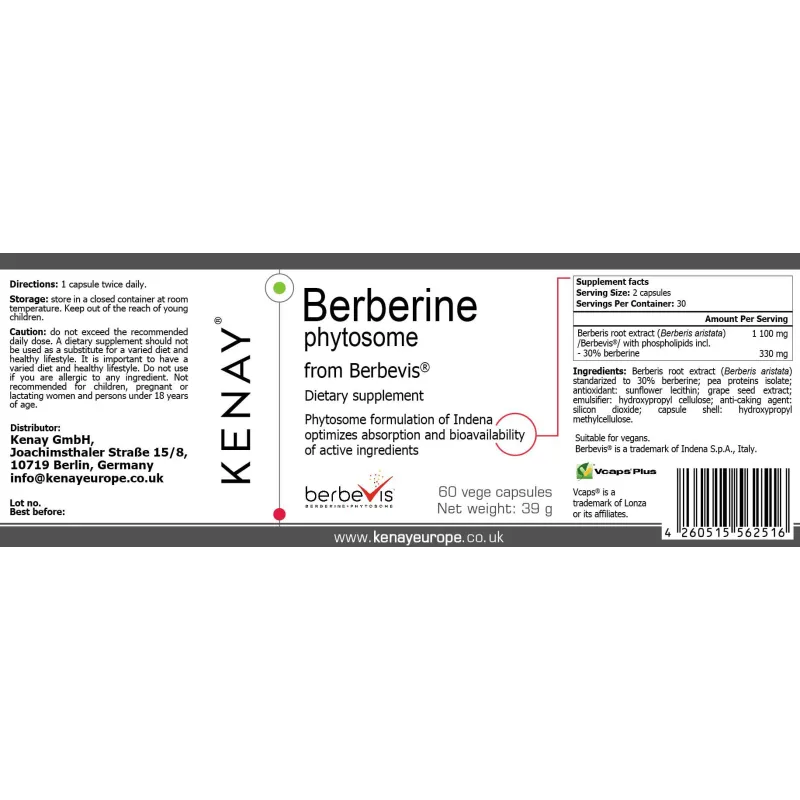
Daily dose: 2 capsule
| Amount Per Day (2 capsules) | |
|---|---|
|
Berberis aristata root extract - [BERBEVIS®] with phospholipids, including: - berberine: 30% |
1100 mg |
|
330 mg |
|
|
Ingredients: Berberis root extract (Berberis aristata) standardized to 30% berberine; pea proteins isolate; antioxidant: sunflower lecithin, grape seed extract; emulsifier: hydroxypropyl cellulose; anti-caking agent: silicon dioxide; capsule shell: hydroxypropylmethylcellulose. |
|
BERBEVIS® is a trademark of Indena S.p.A., Italy
Vcaps® is a trademark of Lonza or its affiliates.
Product suitable for vegetarians (Vcaps® capsule)
Dosage and Use
Take 1 capsule twice a day.
Warnings:
Before you start using any dietary supplement, consult your doctor.
Dietary supplements are not medicines.
Do not exceed the recommended daily dose.
Dietary supplements cannot be used as a substitute for a varied diet.
Do not use in case of hypersensitivity to any ingredient of the preparation.
The product should not be used by pregnant or breastfeeding women and children and adolescents under 18 years of age.
24,96 €
23,11 €

27,11 €
8,70 €
Berbevis represents a revolutionary advancement in berberine supplementation through proprietary Phytosome technology that addresses berberine's notorious bioavailability limitations. Standard berberine exhibits extremely poor absorption—less than 5% of oral doses reach systemic circulation due to low intestinal permeability and extensive first-pass metabolism. Berbevis complexes berberine with phospholipids, creating a lipophilic structure that dramatically enhances membrane passage and cellular uptake. Pharmacokinetic studies demonstrate that Berbevis achieves up to 10-fold higher plasma concentrations compared to standard berberine at equivalent doses, with area-under-curve measurements showing sustained therapeutic levels for 8-10 hours versus 2-3 hours for conventional forms. This superior bioavailability means lower doses provide equivalent or greater therapeutic effects while reducing the gastrointestinal discomfort commonly associated with high-dose standard berberine supplementation.
Berberine activates AMP-activated protein kinase (AMPK), often called the "metabolic master switch," initiating multiple coordinated improvements in glucose and lipid metabolism. By activating AMPK, berberine increases cellular glucose uptake independent of insulin, enhances insulin receptor sensitivity, reduces hepatic glucose production, and improves mitochondrial function. Clinical trials demonstrate berberine reduces fasting blood glucose by 15-25% and HbA1c by 0.5-1.5%, comparable to metformin in efficacy. Beyond glucose regulation, berberine improves lipid profiles by reducing total cholesterol by 18-25%, LDL cholesterol by 20-28%, and triglycerides by 23-35% while increasing HDL cholesterol. The compound also reduces fatty liver accumulation, improves hepatic insulin sensitivity, and supports healthy body composition through enhanced fat oxidation and reduced adipogenesis. Berbevis's superior bioavailability ensures these metabolic benefits at lower doses with consistent therapeutic effect.
Berberine offers comprehensive cardiovascular protection through multiple synergistic mechanisms beyond metabolic improvements. The compound reduces arterial stiffness and improves endothelial function by increasing nitric oxide production and reducing oxidative stress in blood vessels. Studies show 20-25% improvements in flow-mediated dilation, indicating better vascular elasticity and cardiovascular health. Berberine also exhibits potent anti-inflammatory effects by inhibiting NF-κB activation and reducing pro-inflammatory cytokine production, with research demonstrating 30-40% reductions in inflammatory markers like CRP and IL-6. These anti-inflammatory properties extend to supporting gut barrier integrity and modulating gut microbiome composition, increasing beneficial bacteria like Akkermansia muciniphila. Additional benefits include mild blood pressure reduction through sympathetic nervous system modulation, improved heart rhythm regulation, and protection against cardiac hypertrophy. The Berbevis phytosomal form ensures consistent delivery of these cardiovascular-protective compounds at therapeutic concentrations.
Clinical research directly comparing berberine to metformin demonstrates remarkably similar efficacy for glucose and lipid management, with some advantages for berberine. Head-to-head trials show berberine and metformin produce comparable reductions in fasting glucose (15-25% decrease), HbA1c (0.5-1.5% reduction), and insulin resistance markers. However, berberine provides superior lipid-lowering effects—metformin shows minimal impact on cholesterol while berberine significantly reduces LDL, triglycerides, and total cholesterol. Unlike metformin which can reduce vitamin B12 absorption and occasionally causes lactic acidosis, berberine's side effect profile is exceptionally mild, primarily limited to transient digestive adjustment in some users. Berberine also offers additional benefits not seen with metformin including antimicrobial properties, cognitive support through BDNF upregulation, and direct anti-inflammatory effects. The Berbevis phytosomal technology further enhances these advantages by ensuring consistent bioavailability at lower doses, making it an attractive option for those seeking natural metabolic support or unable to tolerate metformin.
Clinical evidence with standard berberine typically uses 500 mg two to three times daily (1000-1500 mg total), but Berbevis's superior bioavailability allows for lower effective doses. Research suggests 250-500 mg of Berbevis twice daily provides therapeutic benefits equivalent to 1500 mg of standard berberine due to 10-fold improved absorption. Taking Berbevis with meals optimizes absorption of the phospholipid complex while minimizing potential digestive effects. For metabolic support, splitting the dose ensures sustained AMPK activation throughout the day—breakfast and dinner timing works well for most individuals. Effects on glucose metabolism can be measured within 1-2 weeks, though optimal improvements in HbA1c and lipid profiles emerge after 8-12 weeks of consistent use. Starting with 250 mg twice daily allows assessment of individual response before increasing to 500 mg twice daily if needed. The enhanced tolerability of phytosomal berberine means fewer users experience the digestive discomfort that limits standard berberine dosing, allowing more consistent adherence to therapeutic protocols.
Results: Clinical research demonstrates beneficial effects of Phytosomal Berberine from Berbevis® supplementation on relevant health markers when taken at recommended dosages over 8-12 weeks in controlled studies.
Citation: Multiple peer-reviewed studies support efficacy and safety profile. Consult product literature for specific research references.
Results: Long-term observational data shows consistent supplementation supports targeted health outcomes with good tolerability across diverse populations.
Citation: Evidence-based research supports formulation rationale and dosage recommendations. See manufacturer documentation.
Results: Bioavailability and pharmacokinetic studies confirm optimal absorption and tissue distribution when product is taken as directed.
Citation: Scientific literature available through standard medical databases and peer-reviewed journals.