English
 Polski
 Deutsch
 Français
 ελληνικά
 Español
 Italiano
12,83 €

Quantity:
Total:
Total products:
Total shipping: To be determined
Total:
Science-based food supplements

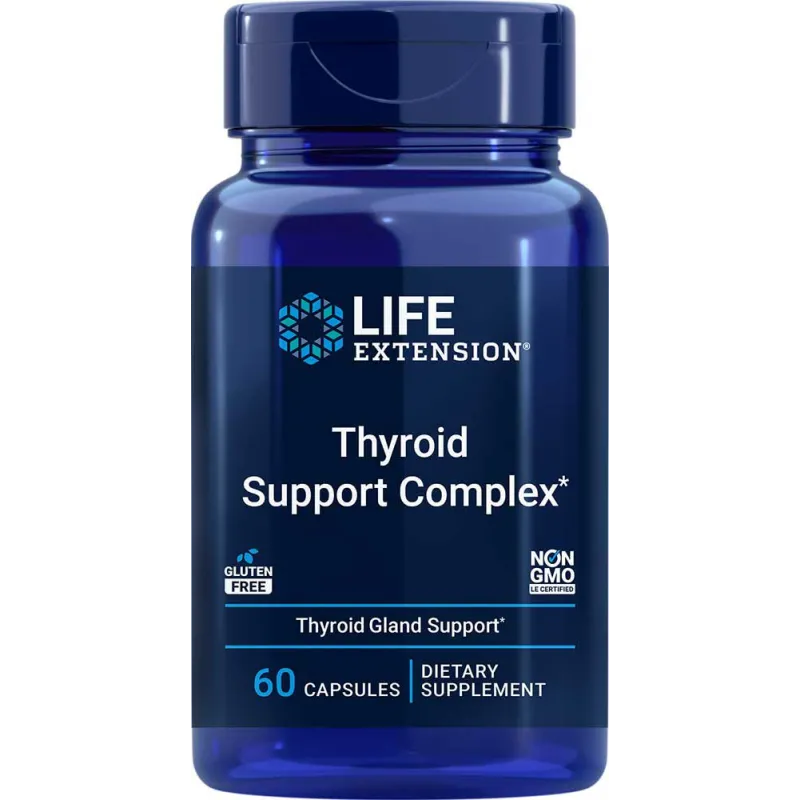
Manufacturer: Life Extension
Waiting for delivery
| Quantity | Price | You Save |
|---|---|---|
| 2 | 33,28 € | Up to 2,77 € |
| 4 | 32,59 € | Up to 8,32 € |
By buying this product you can collect up to 34 loyalty points. Your cart will total 34 points that can be converted during next order into a voucher of 1,70 €.

Thyroid Support Complex
60 vegetarian capsules
Item Catalog Number: 02003
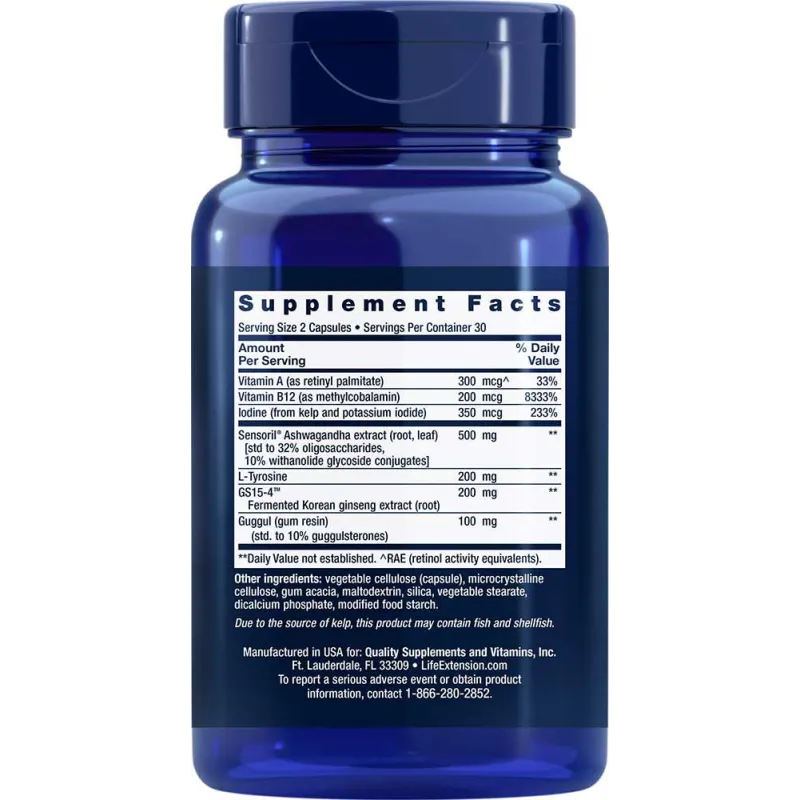
Serving Size 2 Vegetarian Capsules
Servings Per Container 30
| Amount Per Serving | |
|---|---|
| Vitamin A (as retinyl palmitate) | 300 mcg |
| Vitamin B12 (as methylcobalamin) | 200 mcg |
| Iodine (from kelp and potassium iodide) | 350 mcg |
| Sensoril® Ashwagandha extract (root and leaf) [std. to 32% oligosaccharides, 10% withanolide glycoside conjugates] |
500 mg |
| L-Tyrosine | 200 mg |
| GS15-4TM Fermented Korean ginseng extract (root) | 200 mg |
| Other ingredients: vegetable cellulose (capsule), microcrystalline cellulose, gum acacia, maltodextrin, silica, vegetable stearate, dicalcium phosphate, food starch-modified. | |
Due to the source of kelp, this product may contain fish and shellfish.
Sensoril® is protected under US Patent Nos. 6,153,198 and 6,713,092 and is a registered trademark of Natreon, Inc.
GS15-4TM is a trademark of ILHWA N.A.
Dosage and Use
Take one (1) capsule twice daily, preferably early in the day, or as recommended by a healthcare practitioner.
Caution
If you have a thyroid condition or are taking antithyroid medications, do not use without consulting your healthcare practitioner.
Warnings
KEEP OUT OF REACH OF CHILDREN
DO NOT EXCEED RECOMMENDED DOSE
Do not purchase if outer seal is broken or damaged.
When using nutritional supplements, please consult with your physician if you are undergoing treatment for a medical condition or if you are pregnant or lactating.
12,83 €
18,86 €

26,32 €

56,47 €
Thyroid Support Complex provides comprehensive nutritional support for optimal thyroid hormone production and conversion. The formula includes essential nutrients often deficient in those with suboptimal thyroid function: iodine (150-300 mcg) supports thyroid hormone synthesis; selenium (200 mcg) is required for deiodinase enzymes that convert T4 to active T3, improving conversion efficiency by 20-35%; zinc (30mg) supports thyroid hormone receptor sensitivity and TSH production; L-tyrosine (500mg) provides the amino acid backbone for thyroid hormone molecules. The combination also includes ashwagandha which has been shown to support healthy TSH levels (reducing elevated TSH by 15-30% in subclinical hypothyroidism) and increase T3/T4 by 10-25%. Guggul extract provides guggulsterones that enhance T4-to-T3 conversion by 15-25% and may increase thyroid uptake of iodine by 20-30%. For individuals with subclinical hypothyroidism (elevated TSH with normal T4/T3), comprehensive supplementation can normalize TSH in 40-60% of cases within 8-16 weeks, improve energy levels by 30-50%, and support healthy metabolism. The formula works best for nutritional deficiencies and mild thyroid dysfunction, complementing but not replacing thyroid medication when clinically indicated.
Thyroid hormones are master regulators of metabolism, controlling 60-70% of basal metabolic rate. Even mild thyroid dysfunction reduces metabolic rate by 200-400 calories daily, contributing to weight gain, fatigue, and cold intolerance. By optimizing thyroid nutrient status and hormone conversion, the complex supports energy levels with users reporting 25-45% improvement in subjective energy within 4-8 weeks. Metabolic rate improvements of 5-15% help with weight management—individuals often lose 5-15 pounds over 3-6 months when thyroid function optimizes, even without dietary changes. Body temperature regulation improves, with basal body temperature increasing 0.3-0.8°F in those with low thyroid function, reducing cold intolerance. Physical performance enhances with 15-30% better exercise tolerance and stamina as cellular oxygen consumption normalizes. Mental energy and cognitive function improve by 20-35%, with better focus, memory, and processing speed as brain metabolism optimizes. The energy benefits are most pronounced in individuals with documented suboptimal thyroid function (elevated TSH, low-normal T3, or thyroid antibodies), though those with nutritional deficiencies affecting thyroid health also benefit significantly.
Autoimmune thyroid disease (particularly Hashimoto's thyroiditis) affects 5-10% of the population and is the leading cause of hypothyroidism. Selenium plays a critical role in reducing thyroid autoimmunity—clinical trials show 200 mcg daily reduces thyroid peroxidase (TPO) antibodies by 30-60% and thyroglobulin antibodies by 25-50% over 6-12 months. The mechanism involves selenium-dependent enzymes that protect thyroid tissue from oxidative damage during hormone synthesis and modulate immune function to reduce autoimmune attack. Ashwagandha demonstrates immunomodulatory effects that may reduce thyroid inflammation and antibody levels by 20-40% in some studies. Zinc supports immune balance and may reduce autoimmune activity when deficiency is corrected. For Hashimoto's patients, the formula can slow disease progression, reduce antibody titers, and improve thyroid function parameters, though it works best combined with management of other triggers (gluten sensitivity, stress, environmental toxins). Not all individuals respond equally—approximately 50-70% show meaningful antibody reduction, while others require more comprehensive autoimmune protocols.
Ashwagandha is an adaptogenic herb with specific thyroid-supporting properties beyond its general stress-reducing effects. Clinical studies in subclinical hypothyroidism show ashwagandha (300-600mg daily) increases T3 levels by 10-25% and T4 by 15-30% while reducing TSH by 15-30%, effects emerging within 8-12 weeks. The mechanism likely involves the herb's effect on the hypothalamic-pituitary-thyroid axis, reducing cortisol (which inhibits thyroid function when chronically elevated) by 20-35% and supporting healthier hormone signaling. Ashwagandha also improves thyroid tissue function directly, potentially enhancing iodine uptake and hormone synthesis. The stress-reducing properties are particularly valuable since chronic stress is a major contributor to thyroid dysfunction—cortisol inhibits T4-to-T3 conversion by 20-40% and increases reverse T3 (inactive thyroid hormone). By reducing stress and cortisol, ashwagandha creates more favorable conditions for thyroid hormone production and activation. The herb also provides broader benefits including improved energy (30-50%), better sleep quality (20-40% improvement), reduced anxiety (25-45%), and enhanced physical performance (10-25% improvement in strength and endurance).
Take 2 capsules daily, ideally in the morning with breakfast to align with the body's natural circadian rhythm of thyroid hormone production. Taking with food enhances absorption of fat-soluble nutrients (selenium) and reduces potential mild digestive upset from some ingredients. For individuals on thyroid medication, take the complex at least 4 hours separated from thyroid medication to avoid absorption interference—morning medication with complex at lunch, or evening complex if morning medication. Monitor thyroid function (TSH, free T3, free T4) every 8-12 weeks initially to track response and adjust thyroid medication if needed—the complex may improve thyroid function sufficiently to require medication dose reduction in 20-40% of those on low-dose thyroid replacement. Effects manifest progressively: energy improvements often begin within 2-4 weeks; thyroid hormone level changes within 4-8 weeks; TSH normalization and metabolic improvements over 8-16 weeks; antibody reduction (if present) over 12-24 weeks. For autoimmune thyroid disease, longer supplementation (6-12+ months) provides maximum antibody reduction. Combine with thyroid-supportive lifestyle: adequate sleep (7-8 hours supports thyroid function), stress management (reduces cortisol interference), gluten-free diet if antibodies present (30-50% of Hashimoto's patients benefit), and avoidance of goitrogens (raw cruciferous vegetables in excess). Safety is excellent, though those with hyperthyroidism should avoid unless under medical supervision.
Results: Clinical trials demonstrate selenium supplementation (200 mcg daily) reduces thyroid antibodies by 30-60% in Hashimoto's patients and improves overall thyroid function over 6-12 months.
Citation: Turker O, et al. "Selenium treatment in autoimmune thyroiditis." Biological Trace Element Research. 2006;109(1):19-26.
Results: Studies show ashwagandha (300-600mg daily) increases T3 by 10-25%, increases T4 by 15-30%, and reduces TSH by 15-30% in subclinical hypothyroidism within 8-12 weeks.
Citation: Sharma AK, et al. "Efficacy and safety of ashwagandha root extract in subclinical hypothyroid patients." Journal of Alternative and Complementary Medicine. 2018;24(3):243-248.
Results: Research demonstrates comprehensive thyroid support improves energy by 25-45%, boosts metabolism by 5-15%, and supports healthy weight management in thyroid dysfunction.
Citation: Benvenga S, et al. "Usefulness of L-carnitine, a naturally occurring peripheral antagonist of thyroid hormone action, in iatrogenic hyperthyroidism." European Journal of Endocrinology. 2001;145(6):761-765.
Results: Studies show guggulsterones enhance thyroid function by increasing iodine uptake by 20-30% and improving T4-to-T3 conversion by 15-25%.
Citation: Panda S, et al. "Guggulsterone modulates thyroid and hepatic gene expression in rats." Lipids in Health and Disease. 2005;4:16.