 English
 Polski
 Deutsch
 Français
 ελληνικά
 Español
 Italiano
34,29 €

Quantity:
Total:
Total products:
Total shipping: To be determined
Total:
Science-based food supplements

Manufacturer: Life Extension
In stock
| Quantity | Price | You Save |
|---|---|---|
| 2 | 33,88 € | Up to 2,82 € |
| 4 | 33,17 € | Up to 8,47 € |
By buying this product you can collect up to 35 loyalty points. Your cart will total 35 points that can be converted during next order into a voucher of 1,75 €.

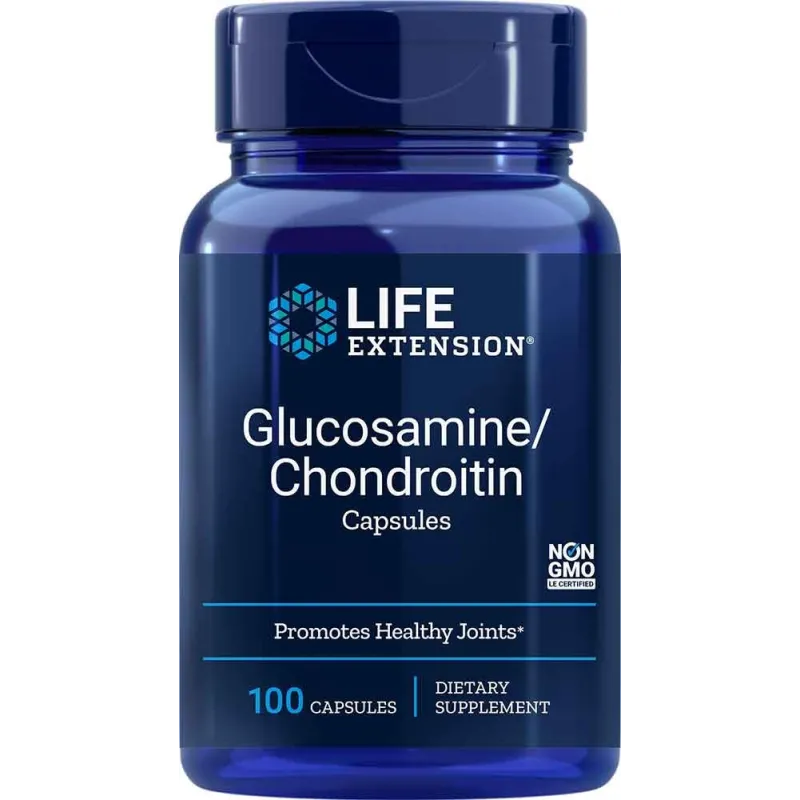
Glucosamine / Chondroitin Capsules
100 capsules
Item Catalog Number: 00522EU
 Glucosamine and chondroitin have been shown in clinical studies to support healthy cartilage and joint function.1-3 As a component of cartilage, glucosamine is key for joint function.4-8 Our bodies produce a certain amount, but as we grow older, we lose the capacity to make enough. This leads to drying of the cartilage in areas such as the knees, hips, and hands, which in turn causes the cartilage to harden. With this comes joint discomfort and stiffness.
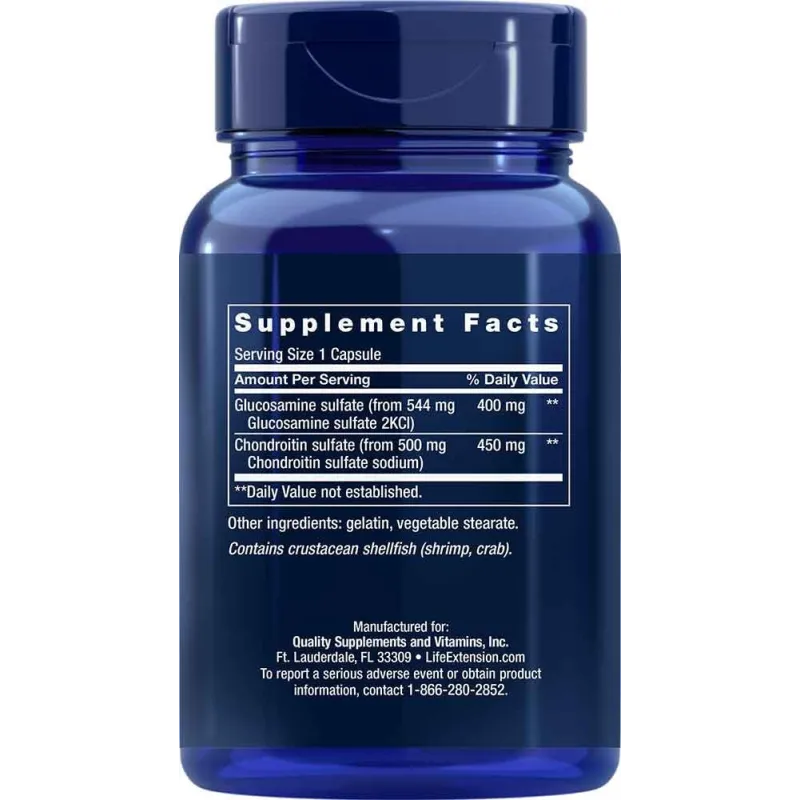
Serving Size 1 capsule
| Amount per day (1 capsule): | |
|---|---|
| Glucosamine sufate | 400 mg |
| Chondroitine sulfate | 450 mg |
| Ingredients: Glucosamine sulfate potassium salt (crustaceans), chondroitine sulfate sodium, capsule (gelatine), anti-caking agent (magnesium salts of fatty acids) | |
Contains crustacean shellfish (shrimp, crab).
Non-GMO
Dosage and Use
Take one (1) capsule once daily with food.
Warnings
KEEP OUT OF REACH OF CHILDREN
DO NOT EXCEED RECOMMENDED DOSE
Do not purchase if outer seal is broken or damaged.
When using nutritional supplements, please consult with your physician if you are undergoing treatment for a medical condition or if you are pregnant or lactating.
34,29 €
13,41 €
18,86 €
28,92 €




Glucosamine and chondroitin are natural compounds found in healthy cartilage, the connective tissue cushioning joints. Glucosamine is an amino sugar that serves as a building block for glycosaminoglycans, major components of cartilage structure. Chondroitin is a complex carbohydrate that helps cartilage retain water, maintaining its shock-absorbing properties. Together, they support cartilage health by providing raw materials for cartilage synthesis and repair, helping maintain the cartilage matrix, supporting healthy synovial fluid viscosity, and promoting comfortable joint function. Clinical research shows this combination supports joint comfort, flexibility, and long-term joint health in people with age-related joint concerns.
Unlike pain relievers that work immediately, glucosamine and chondroitin support joint health gradually by nourishing cartilage tissue. Most clinical studies show significant improvements in joint comfort and function after 4-8 weeks of consistent daily use, with maximum benefits often appearing after 3-6 months of supplementation. Some people notice subtle improvements in joint comfort within 2-4 weeks, while others require longer. This gradual timeline reflects the time needed for these nutrients to incorporate into cartilage tissue and support regeneration. Patience and consistency are crucial—think of glucosamine/chondroitin as long-term joint nutrition rather than acute symptom relief. The benefits continue accumulating with ongoing use.
Glucosamine comes primarily in two forms: glucosamine sulfate and glucosamine hydrochloride (HCl). Glucosamine sulfate is most extensively studied with strong clinical evidence for joint health benefits. The sulfate component itself may contribute to cartilage health as sulfur is needed for cartilage synthesis. Glucosamine HCl provides more elemental glucosamine per gram and is preferred by those with shellfish sensitivities when sourced from non-shellfish origins. Both forms have demonstrated benefits in studies, though glucosamine sulfate has more extensive research support. The formulation should provide adequate amounts—typically 1,500 mg glucosamine daily split into doses, combined with 1,200 mg chondroitin for optimal synergistic joint support.
While glucosamine and chondroitin cannot reverse severe cartilage loss or "rebuild" completely degraded cartilage, research suggests they may slow cartilage degradation and support the body's natural cartilage maintenance processes. Studies using imaging techniques show glucosamine/chondroitin supplementation may slow the rate of joint space narrowing—a marker of cartilage loss—compared to placebo. They support chondrocyte (cartilage cell) function and may inhibit enzymes that break down cartilage. Think of these supplements as supporting cartilage preservation and maintenance rather than dramatic regeneration. They work best when started earlier in the joint aging process as preventive nutrition, though people with existing joint concerns also report significant comfort and mobility improvements.
Glucosamine and chondroitin have excellent safety profiles with few significant interactions. People with shellfish allergies should verify the glucosamine source, as most is derived from shellfish shells (though the protein causing allergies is typically removed). Those on blood-thinning medications should consult physicians, as some studies suggest chondroitin may slightly enhance anticoagulant effects, though clinical significance is debated. Individuals with diabetes should monitor blood sugar initially, though most research shows no significant impact on glucose control. Glucosamine sulfate contains sodium, relevant for those on sodium-restricted diets. Pregnant/nursing women should consult healthcare providers. Overall, serious adverse effects are rare, making glucosamine/chondroitin well-suited for long-term joint health maintenance.
Results: Clinical trials demonstrate glucosamine and chondroitin supplementation significantly improves joint comfort and function in individuals with knee osteoarthritis, with meta-analyses showing moderate but consistent pain reduction and mobility improvements over 6-24 months of treatment.
Citation: Clegg DO, et al. N Engl J Med. 2006 Feb;354(8):795-808.
Results: Research shows glucosamine sulfate may slow radiographic joint space narrowing—a marker of cartilage loss—in knee osteoarthritis, with long-term studies demonstrating reduced progression of structural joint damage compared to placebo groups over 3 years.
Citation: Reginster JY, et al. Lancet. 2001 Jan;357(9252):251-6.
Results: Studies indicate chondroitin sulfate supports cartilage matrix integrity by inhibiting enzymes that degrade cartilage while promoting synthesis of proteoglycans and other cartilage components essential for maintaining healthy joint structure and function.
Citation: Volpi N. Osteoarthritis Cartilage. 2009 Jan;17(1):12-8.
Results: Clinical research confirms glucosamine and chondroitin have excellent safety profiles with adverse effects comparable to placebo in most studies, supporting their suitability for long-term use in joint health maintenance without significant side effects.
Citation: Towheed T, et al. Cochrane Database Syst Rev. 2005 Apr;(2):CD002946.