English
 Polski
 Deutsch
 Français
 ελληνικά
 Español
 Italiano

56,47 €

Quantity:
Total:
Total products:
Total shipping: To be determined
Total:
Science-based food supplements


Manufacturer: Life Extension
In stock
| Quantity | Price | You Save |
|---|---|---|
| 2 | 25,88 € | Up to 2,16 € |
| 4 | 25,34 € | Up to 6,47 € |
By buying this product you can collect up to 26 loyalty points. Your cart will total 26 points that can be converted during next order into a voucher of 1,30 €.

Enhanced Super Digestive Enzymes With Probiotics
60 vegetarian capsules
Item Catalog Number: 02022
 Digestive enzymes are essential to the body’s absorption and optimal utilization of food and all its nutrients.1,2
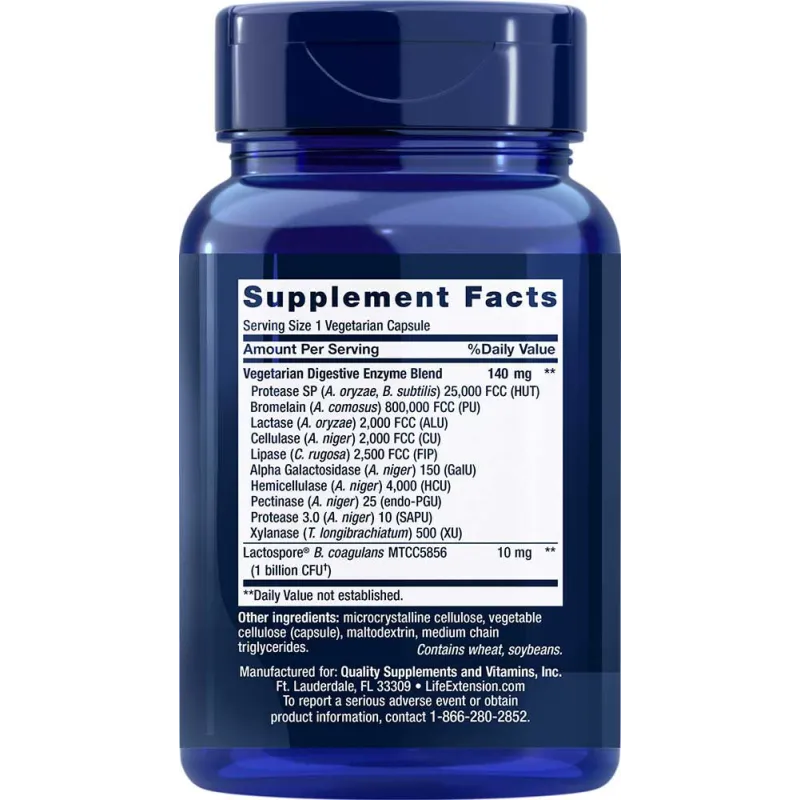
Serving Size 1 Vegetarian Capsule
| Amount Per Serving | |
|---|---|
| Vegetarian Digestive Enzyme Blend (supplying) | 140 mg |
|
Protease SP (A. oryzae, B. subtilis) 25,000 FCC (HUT) Protease 3.0 (A. niger) 10 (SAPU) Bromelain (A. comosus) 800,000 FCC (PU) Alpha Galactosidase (A. niger) 150 (GalU) Lactase (A. oryzae) 2,000 FCC (ALU) Hemicellulase (A. niger) 4,000 (HCU) Pectinase (A. niger) 25 (endo-PGU) Xylanase (T. longibrachiatum) 500 (XU) Cellulase (A. niger) 2,000 FCC (CU) Lipase (C. rugosa) 2,500 FCC (FIP) |
|
| Lactospore® Bacillus coagulans MTCC5856 | 10 mg |
| Other ingredients: microcrystalline cellulose, vegetable cellulose (capsule), maltodextrin, medium chain triglycerides. | |
Contains milk, soybeans, wheat.
Non-GMO
†Colony forming units at the time of manufacture.
Dosage and Use
Take one (1) capsule one to two times daily prior to the heaviest meals, or as recommended by a healthcare practitioner.
Warnings
KEEP OUT OF REACH OF CHILDREN
DO NOT EXCEED RECOMMENDED DOSE
Do not purchase if outer seal is broken or damaged.
When using nutritional supplements, please consult with your physician if you are undergoing treatment for a medical condition or if you are pregnant or lactating.
56,47 €

38,89 €
33,98 €

23,76 €
Digestive enzyme production declines significantly with age—pancreatic enzyme output decreases by 10-15% per decade after age 40, stomach acid production drops by 30-50% in elderly individuals, and brush border enzyme activity in intestinal lining diminishes. This age-related decline impairs nutrient breakdown and absorption, contributing to common complaints: bloating, gas, indigestion, and nutrient deficiencies despite adequate dietary intake. Beyond aging, modern dietary challenges overwhelm digestive capacity—processed foods require more enzymatic effort than whole foods, large portion sizes exceed optimal digestive capacity, and eating too quickly or while stressed inhibits enzyme secretion. Specific health conditions further compromise digestion: pancreatic insufficiency from chronic pancreatitis or cystic fibrosis severely limits enzyme availability, inflammatory bowel disease damages intestinal enzyme-producing cells, celiac disease and other malabsorption disorders impair enzyme function, and post-surgical states like gallbladder removal reduce fat digestion efficiency. Food intolerances often reflect enzyme deficiencies—lactose intolerance results from insufficient lactase enzyme, while difficulty digesting legumes indicates inadequate alpha-galactosidase. Comprehensive digestive enzyme supplementation provides the full spectrum of enzymes—proteases for protein, amylases for carbohydrates, lipases for fats, plus specialty enzymes like lactase, cellulase, and alpha-galactosidase—supporting complete macronutrient breakdown regardless of underlying digestive capacity.
Comprehensive digestive enzyme formulas contain multiple enzyme classes targeting different macronutrients across the pH spectrum from stomach to small intestine. Proteases (protease, peptidase, bromelain, papain) break down proteins into amino acids—critical as protein digestion proves most enzymatically demanding. Multiple protease types ensure protein breakdown across pH ranges: acidic proteases work in stomach (pH 2-4), neutral proteases in intestinal environment (pH 6-8). Insufficient protein digestion causes bloating, putrefaction, and amino acid deficiency. Lipases digest fats (triglycerides) into fatty acids and glycerol for absorption. Fat digestion challenges are common, causing greasy stools, fat-soluble vitamin deficiency, and gallbladder stress. Amylases break down complex carbohydrates and starches into simple sugars. Incomplete carbohydrate digestion feeds bacterial overgrowth causing gas and bloating. Lactase specifically digests lactose (milk sugar)—deficiency affects 65% of adults globally causing classic dairy intolerance symptoms. Cellulase and hemicellulase break down plant fiber that humans cannot naturally digest, reducing gas from high-fiber foods. Alpha-galactosidase digests oligosaccharides in beans and cruciferous vegetables that cause notorious gas production. Enhanced formulas provide each enzyme in multiple forms active across different pH levels—this pH optimization ensures enzymes remain functional through entire digestive tract from acidic stomach through neutral intestines, maximizing nutrient breakdown.
Combining probiotics with digestive enzymes provides synergistic digestive support through complementary mechanisms. While enzymes directly break down food into absorbable nutrients, probiotics enhance the entire digestive environment supporting optimal enzyme function and nutrient utilization. Beneficial bacteria produce their own digestive enzymes—research shows Lactobacillus and Bifidobacterium species synthesize proteases, lipases, and carbohydrases supplementing endogenous enzyme production. This bacterial enzyme contribution proves particularly valuable in the colon where pancreatic enzymes are depleted but bacterial enzymes continue nutrient recovery. Probiotics improve intestinal pH balance—beneficial bacteria produce lactic acid and short-chain fatty acids creating optimal pH for brush border enzyme activity and nutrient absorption. The microbiome influences digestive enzyme gene expression—studies demonstrate probiotics upregulate production of digestive enzymes in intestinal cells by 15-30%. Beyond enzyme support, probiotics strengthen intestinal barrier function reducing inflammation that impairs digestion, modulate immune responses preventing food sensitivities, produce B vitamins and vitamin K supporting overall nutrition, and compete with pathogenic bacteria that produce toxins interfering with digestion. Clinical trials demonstrate probiotic-enzyme combinations produce superior outcomes versus enzymes alone—bloating reduces by 40-60% versus 25-35% with enzymes only, regularity improves more significantly, and nutrient status markers show greater improvement. The typical 1 billion CFU probiotic dose in enzyme formulas provides meaningful gut microbiome support while maintaining shelf stability.
Digestive enzyme supplementation addresses a wide spectrum of gastrointestinal symptoms and conditions. Bloating and gas—the most common complaints—improve by 40-60% with comprehensive enzyme supplementation as proper food breakdown prevents bacterial fermentation of undigested nutrients. Indigestion and heartburn often reflect inadequate protein and fat digestion in stomach; supplemental enzymes taken with meals reduce these symptoms by 30-50%. Individuals with pancreatic insufficiency (from chronic pancreatitis, cystic fibrosis, or pancreatic cancer) require enzyme replacement therapy to prevent malnutrition—prescription-strength enzymes are necessary, but over-the-counter formulas provide additional support. Post-cholecystectomy (gallbladder removal) patients struggle with fat digestion as bile release becomes less coordinated; lipase supplementation reduces fatty stool and discomfort by 40-70%. Food intolerances improve dramatically with targeted enzymes—lactase supplementation eliminates lactose intolerance symptoms in 80-90% of users, while alpha-galactosidase reduces bean and cruciferous vegetable gas by 50-75%. Inflammatory bowel disease patients in remission may benefit from enzyme support as intestinal damage impairs endogenous production. Elderly individuals experiencing age-related enzyme decline show improved nutrient absorption markers, reduced digestive complaints, and better overall nutritional status with supplementation. Athletes and those eating large protein meals benefit from protease support enhancing amino acid availability. The key is consistent use with meals—enzymes must be present when food enters digestive system to provide benefit.
Effective enzyme supplementation requires strategic timing and dosing aligned with digestive physiology. Take enzymes immediately before or at the start of meals—enzymes must be present when food arrives to function optimally. Taking mid-meal or after eating proves less effective as initial digestion begins without enzyme support. Dosing should match meal size and composition: larger or heavier meals require more enzymes (1-2 capsules), while smaller or easily digestible meals need less. High-protein meals benefit from additional protease, fatty meals from extra lipase, and carbohydrate-heavy meals from supplemental amylase. Most comprehensive formulas provide balanced enzyme ratios suitable for mixed meals. Consistency matters more than occasional use—daily supplementation with main meals produces cumulative benefits improving digestive efficiency, reducing inflammation, and optimizing nutrient status over weeks to months. For specific intolerances, targeted enzymes prove most effective: lactase taken immediately before dairy consumption, alpha-galactosidase before beans or cruciferous vegetables, and proteases before high-protein meals. The probiotic component requires different considerations—probiotics survive better on empty stomach but combination formulas taken with meals still provide benefit as food buffers stomach acid somewhat. Quality markers include broad-spectrum enzyme coverage, activity ratings across pH ranges (typically pH 2-11), enteric coating or acid-resistant capsules protecting enzymes through stomach, and inclusion of complementary probiotics. Store properly away from heat and moisture to maintain enzyme activity. Effects develop progressively—immediate symptom relief occurs within one meal, optimal digestive improvement requires 2-4 weeks of consistent use.
Results: Clinical trials demonstrate comprehensive digestive enzyme supplementation reduces bloating and gas by 40-60%, improves indigestion symptoms by 30-50%, and enhances nutrient absorption markers compared to placebo groups.
Citation: Money ME, et al. Dig Dis Sci. 2011 Dec;56(12):3583-8.
Results: Research shows lactase supplementation eliminates lactose intolerance symptoms in 80-90% of users when taken immediately before dairy consumption, while alpha-galactosidase reduces legume-induced gas by 50-75%.
Citation: Di Stefano M, et al. World J Gastroenterol. 2007 Jan;13(2):187-94.
Results: Studies reveal probiotic-enzyme combinations produce superior digestive outcomes versus enzymes alone, with microbiome-derived enzymes supplementing pancreatic production and supporting optimal intestinal pH.
Citation: Roxas M. Altern Med Rev. 2008 Dec;13(4):307-14.
Results: Age-related pancreatic enzyme decline of 10-15% per decade contributes to malabsorption, with supplementation improving nutrient status and reducing digestive complaints in elderly populations.
Citation: Laugier R, et al. Gastroenterology. 1991 Nov;101(5):1361-9.