 English
 Polski
 Deutsch
 Français
 ελληνικά
 Español
 Italiano
28,41 €

Quantity:
Total:
Total products:
Total shipping: To be determined
Total:
Science-based food supplements

Manufacturer: Life Extension
In stock
| Quantity | Price | You Save |
|---|---|---|
| 2 | 26,40 € | Up to 2,20 € |
| 4 | 25,85 € | Up to 6,60 € |
By buying this product you can collect up to 27 loyalty points. Your cart will total 27 points that can be converted during next order into a voucher of 1,35 €.

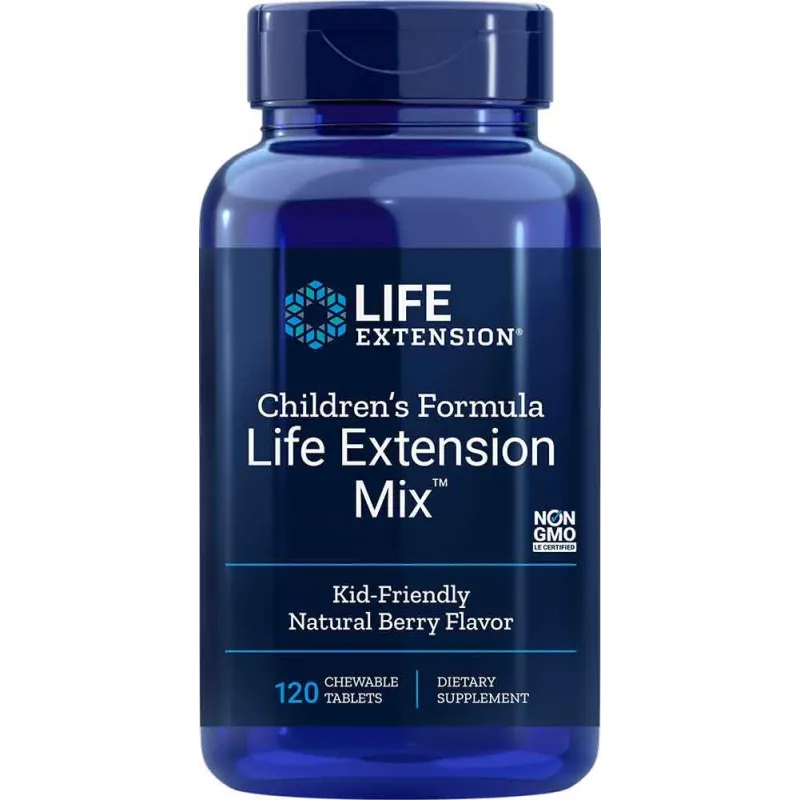
Children’s Formula Life Extension Mix™
120 chewable tablets
Item Catalog Number: 02199
 Children need a sound nutritional basis upon which to grow and develop, so it's important to ensure that they eat a balanced diet. However, with busy schedules, and fast or processed foods, children may not meet all of their recommended daily value of nutrients each day. A daily multinutrient supplement can help provide the nutrition they need to grow up strong and healthy.
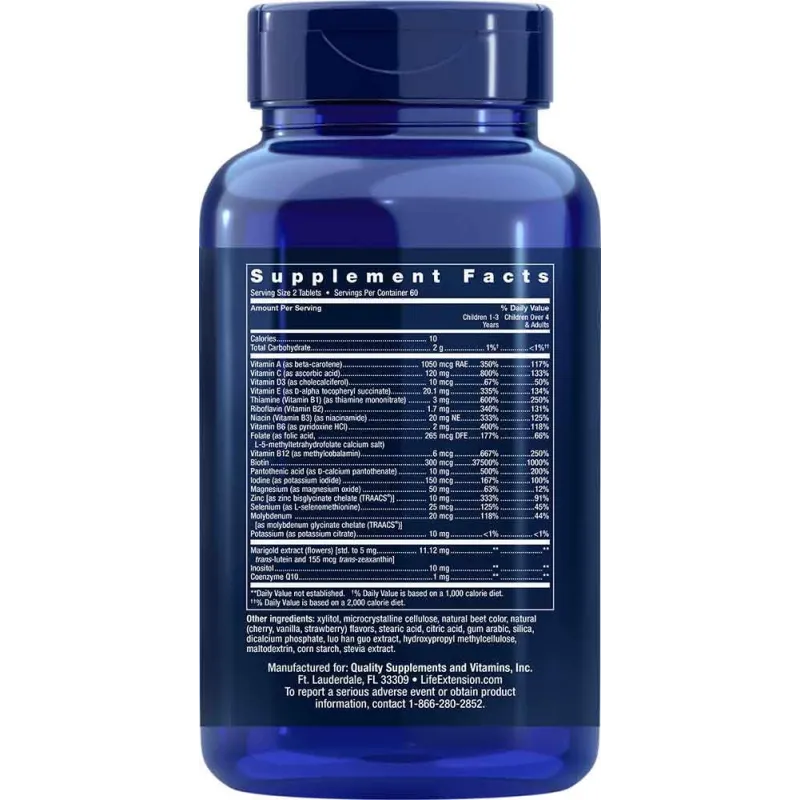
Serving Size 2 tablets
Servings Per Container 60
| Amount Per Serving | |
|---|---|
| Calories | 10 |
| Total Carbohydrates | 2 g |
| Vitamin A (as beta-carotene) | 1050 mcg RAE |
| Vitamin C (as ascorbic acid) | 120 mg |
| Vitamin D3 (as cholecalciferol) | 10 mcg |
| Vitamin E (as D-alpha tocopheryl succinate) | 20.1 mg |
| Thiamine (Vitamin B1) (as thiamine mononitrate) | 3 mg |
| Riboflavin (Vitamin B2) | 1.7 mg |
| Niacin (Vitamin B3) (as niacinamide) | 20 mg NE |
| Vitamin B6 (as pyridoxine HCI) | 2 mg |
| Folate (as folic acid, L-5-methyltetrahydrofolate calcium salt) | 265 mcg DFE |
| Vitamin B12 (as methylcobalamin) | 6 mcg |
| Biotin | 300 mcg |
| Pantothenic acid (as D-calcium pantothenate) | 10 mg |
| Iodine (as potassium iodide) | 150 mcg |
| Magnesium (as magnesium oxide) | 50 mg |
| Zinc (as TRAACS® zinc bisglycinate chelate) | 10 mg |
| Selenium (as L-selenomethionine) | 25 mcg |
| Molybdenum (as TRAACS® molybdenum glycinate chelate) | 20 mcg |
| Potassium (as potassium citrate) | 10 mg |
| Marigold extract (flowers) [std. to 5 mg trans-lutein and 155 mcg trans-zeaxanthin] | 11.2 mg |
| Inositol | 10 mg |
| Coenzyme Q10 | 1 mg |
| Other ingredients: xylitol, microcrystalline cellulose, natural beet color, natural (cherry, vanilla, strawberry) flavors, stearic acid, citric acid, gum arabic, silica, dicalcium phosphate, luo han guo extract, hydroxypropyl methylcellulose, maltodextrin, corn starch, stevia extract. | |
Non-GMO
TRAACS® and Albion® are registered trademarks of Albion Laboratories, Inc.
Dosage and Use
For children 4-8 years of age chew two (2) tablets daily with food, or as recommended by a healthcare practitioner.
For children under the age of 4 consult with a healthcare practitioner before use.
Warnings
KEEP OUT OF REACH OF CHILDREN
DO NOT EXCEED RECOMMENDED DOSE
Do not purchase if outer seal is broken or damaged.
When using nutritional supplements, please consult with your physician if you are undergoing treatment for a medical condition or if you are pregnant or lactating.
28,41 €

38,89 €
27,26 €

14,45 €
Children's nutritional needs prove challenging to meet through diet alone due to multiple converging factors. Modern agricultural practices deplete soil minerals reducing nutrient density in produce by 20-40% compared to 50 years ago. Picky eating behaviors—normal developmental phases affecting 25-50% of children—severely limit dietary variety and nutrient intake. Processed convenience foods dominating many children's diets provide calories but minimal micronutrients. Growing bodies require proportionally higher nutrient levels per kilogram bodyweight than adults for rapid growth, brain development, and immune function maturation. Research demonstrates 30-50% of children show inadequate intake of vitamin D, 20-30% insufficient iron, and 15-25% suboptimal vitamin A, B vitamins, and calcium based on dietary surveys. Comprehensive multivitamin supplementation provides nutritional insurance, filling gaps and supporting optimal physical and cognitive development during critical growth periods.
Brain development during childhood requires specific nutrients in adequate amounts for optimal cognitive outcomes. Iron supports myelin formation coating nerve fibers and neurotransmitter synthesis—deficiency causes irreversible developmental delays, reduced IQ, and behavioral issues. Studies show iron supplementation in deficient children improves cognitive scores by 10-20 points. Iodine proves essential for thyroid hormones regulating brain development, with deficiency the world's leading preventable cause of intellectual disability. Vitamin D receptors throughout the brain indicate its importance for neurodevelopment, with adequate status correlating to better cognitive performance and reduced ADHD symptoms. B vitamins, particularly B12, folate, and B6, support neurotransmitter synthesis and myelin production. Zinc influences neuronal signaling and synaptic plasticity. Omega-3 DHA comprises 40% of brain fatty acids supporting membrane fluidity critical for learning and memory. Comprehensive formulations providing these nutrients at pediatric-appropriate doses support optimal cognitive development and school performance.
Children's developing immune systems require specific nutrients for proper maturation and function, influencing illness frequency and severity. Vitamin D demonstrates particularly robust immune effects—adequate status reduces respiratory infection rates by 30-50% through enhancement of innate immunity and antimicrobial peptide production. Vitamin C supports multiple immune functions including phagocyte activity, antibody production, and epithelial barrier integrity, with deficiency increasing infection susceptibility. Zinc proves critical for immune cell development and function—supplementation reduces pneumonia incidence by 40% and diarrhea duration by 20-30% in deficient children. Vitamin A supports mucosal immunity in respiratory and digestive tracts, with supplementation programs reducing all-cause mortality by 12-24% in developing countries. Iron, while essential for immune function, requires balanced supplementation as both deficiency and excess impair immunity. Selenium supports antioxidant enzymes protecting immune cells from oxidative damage. Research shows children taking comprehensive multivitamins experience 20-35% fewer sick days and reduced antibiotic use compared to unsupplemented peers.
Childhood and adolescence represent critical windows for bone mass accumulation—50% of peak bone mass accrues during teenage years, determining lifelong fracture risk and osteoporosis susceptibility. Calcium provides the primary mineral component of bone, with inadequate intake limiting bone mineralization. Vitamin D enables calcium absorption and supports osteoblast function—deficiency causes rickets in severe cases and suboptimal bone density commonly. Vitamin K2 activates osteocalcin, directing calcium into bone matrix rather than soft tissues. Magnesium comprises bone crystal structure and supports vitamin D metabolism. Zinc, copper, and manganese serve as cofactors for enzymes involved in collagen cross-linking and bone matrix formation. Vitamin C enables collagen synthesis essential for bone scaffolding. Protein provides amino acids for bone matrix and growth hormones. Studies demonstrate children receiving comprehensive bone-supporting supplementation achieve 3-5% higher bone mineral density compared to unsupplemented peers, potentially reducing lifetime fracture risk by 20-40%.
Selecting appropriate children's multivitamins requires attention to formulation, dosing, and quality standards. Choose products specifically formulated for children with age-appropriate nutrient levels—adult formulations may contain excessive amounts of certain nutrients potentially harmful to children. Avoid products with artificial colors, flavors, or unnecessary additives that may trigger sensitivities or undermine health goals. Look for third-party testing verification (USP, NSF, ConsumerLab) ensuring label accuracy and purity. Chewable tablets or liquid forms increase compliance versus hard-to-swallow pills. Dosing should align with age and weight following product guidelines—typically one tablet or serving daily provides comprehensive coverage without exceeding safe upper limits. Administer with meals to enhance fat-soluble vitamin absorption (A, D, E, K) and minimize potential nausea. Store supplements securely out of children's reach as attractive gummy or candy-like forms pose overdose risk if accessed unsupervised. Monitor for any adverse reactions though high-quality multivitamins rarely cause issues. Continue supplementation consistently through growth years rather than sporadic use for optimal benefit.
Results: Nutritional surveys demonstrate 30-50% of children show inadequate vitamin D intake, 20-30% insufficient iron, and 15-25% suboptimal B vitamins and calcium, with comprehensive multivitamin supplementation filling these critical gaps supporting optimal development.
Citation: Bailey RL, et al. Pediatrics. 2012 Nov;130(5):e1181-90.
Results: Research shows iron supplementation in deficient children improves cognitive test scores by 10-20 points, while vitamin D adequacy reduces respiratory infection rates by 30-50% through enhanced immune function in pediatric populations.
Citation: Grantham-McGregor S, et al. Lancet. 2001 Jan;357(9251):2-8.
Results: Studies reveal children receiving comprehensive bone-supporting nutrition achieve 3-5% higher bone mineral density compared to unsupplemented peers, potentially reducing lifetime fracture risk by 20-40% through optimized peak bone mass accumulation.
Citation: Heaney RP, et al. J Bone Miner Res. 2000 Nov;15(11):2011-8.
Results: Clinical trials demonstrate children taking multivitamins experience 20-35% fewer sick days annually with reduced antibiotic use, attributed to immune-supporting nutrients including zinc, vitamins A, C, and D working synergistically.
Citation: Maggini S, et al. Br J Nutr. 2008 Oct;100(4):1054-64.